
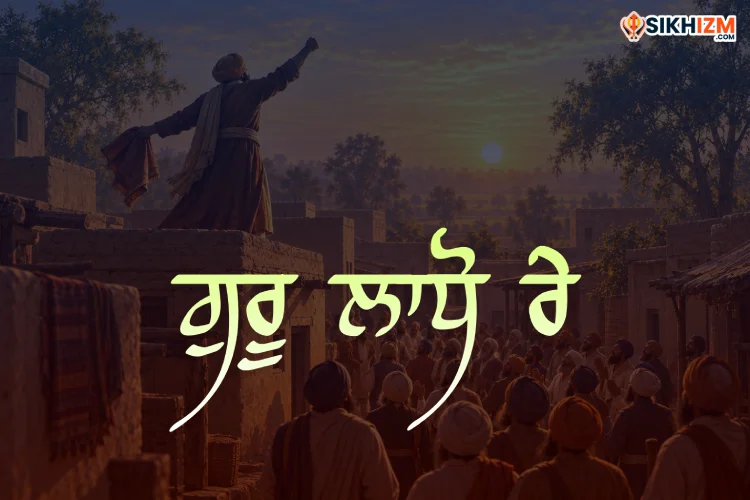
"Guru Ladho Re" — "I have found the Guru!" — is one of the most quoted phrases in Sikh history. It was the cry of Bhai Makhan Shah Lubana, shouted from a rooftop in the small town of Baba Bakala in 1664, the moment he identified Guru Tegh Bahadur Ji as the ninth Nanak. Centuries later, the phrase is still used as shorthand for that discovery — and in recent years it has also become the name of a "Diwas" that some communities, particularly Labana Sikhs, mark on the calendar.
This article looks at three things together, which most retellings keep separate: the story itself, how Guru Tegh Bahadur Ji actually came to be living in Bakala in the first place, and what our earliest sources actually say — versus what later storytelling has added.
How Guru Tegh Bahadur Ji Came to Live at Bakala
The popular version of the story often starts in 1664, as if Guru Tegh Bahadur Ji simply appeared at Bakala out of nowhere to be "discovered." He didn't. He had been living there for years already, well before the question of Guruship ever arose.
As recorded in Katha Puratan Eyon Suni (Satbir Singh): his mother, Mata Nanaki, and the family had settled at Bakala after Guru Hargobind Sahib's time at Kiratpur. Guru Hargobind Sahib is said to have specifically instructed that "Baba" Tegh Bahadur — his youngest son — be treated with the respect due to an elder, establishing his standing well before any Guruship question arose. Through the Guruships of Guru Har Rai and the child-Guru Har Krishan, Tegh Bahadur lived a withdrawn, contemplative life at Bakala — Naam simran, family life, and by some accounts preaching tours through Malwa and Haryana — rather than public leadership.
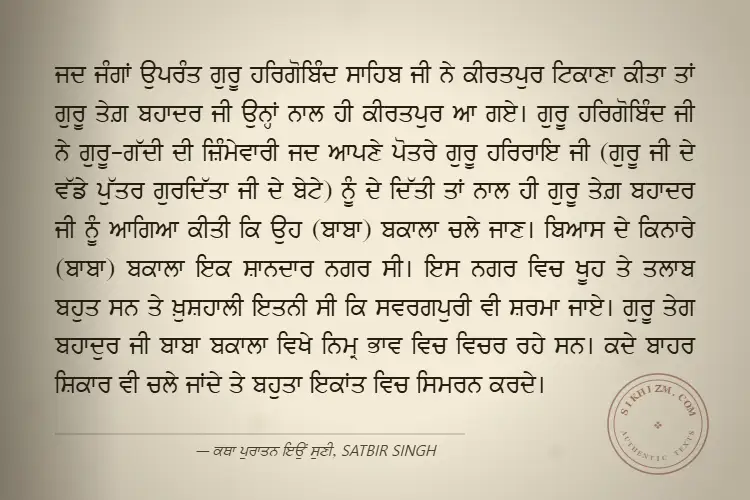
Locally he was known simply as "Tegha" (ਤੇਗ਼ਾ), or in some tellings, dismissively, as "Tegha Kamla" (ਤੇਗ਼ਾ ਸ਼ੁਦਾਈ) — "the reclusive one" or "the eccentric one." That detail matters for everything that follows: Makhan Shah didn't stumble onto a stranger. He found a man who had quietly lived a Guru's life for years before anyone called him one, and whom his own neighbours had half-written off.
By tradition, he spent 26 years, 9 months, and 13 days at Bakala in quiet meditation and contemplation—a stretch of his life that outlasts, by decades, the single dramatic year (1664) most retellings focus on.
The Succession Crisis: "Baba Bakale"
The Succession Crisis: "Baba Bakale"
Guru Har Krishan Sahib, on his deathbed in Delhi in 1664, is remembered as having said only two words when asked who would succeed him: "Baba Bakale" — "[the Guru is] the Baba at Bakala." He did not name Tegh Bahadur directly, and even that much is treated as genuinely ambiguous in at least one near-contemporary account — Kesar Singh Chhibbar's Bansawalinama notes pointedly that it was never settled whether Guru Har Krishan Ji said this while still lucid or only in his final, fading moments.
That single, unspecific phrase created a vacuum. In the confusion that followed, a number of men — accounts usually say around twenty-two — set themselves up as claimants to the Guruship, each hoping to attract the offerings (bheta) and following of pilgrims who arrived not knowing who the real successor was.
What almost no popular retelling mentions is that the succession appears to have been settled, at least twice, before Makhan Shah ever arrived at Bakala — through two quite different processes, recorded in two quite different texts.
The First Thread: A Family Ceremony (Guru Kian Sakhian, Sakhi 19)
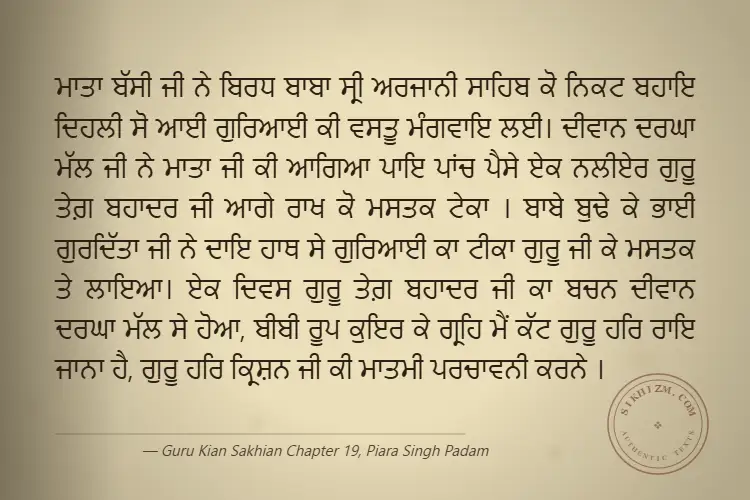
Guru Kian Sakhian — compiled by Bhai Swarup Singh Kaushish and edited in the modern era by Piara Singh Padam, drawing on Bhatt Vahi material — records, in its 19th Sakhi, a formal tilak ceremony that took place roughly five months after Guru Har Krishan Ji's passing, and before the Makhan Shah episode:
A Sikh informed the Guru that Mata Bassi Ji had arrived from Delhi with the Delhi sangat. Guru Tegh Bahadur Ji had Bhai Dayal Das bring them before him. Mata Bassi Ji and Mata Sulakhni (mother of Guru Har Krishan Ji) came forward and bowed at his feet. The Guru seated them near him and offered words of comfort on Guru Har Krishan Ji's passing: "The will of the Formless One cannot be erased... look at how many avatars, rishis and munis have gone before — all accepted the Creator's will as true."
Some days later, at a large mela on the amavas of Bhadon, sangats arrived at Bakala from every direction — from Goindwal (Baba Arjani Sahib, of Guru Amar Das's line), from Amritsar ("Ramdas Nagari," Bhai Gurditta Randhawa of Baba Buddha's lineage, with the Guru Chak sangat), from Kiratpur (Baba Deep Chand), and from Garhwal (Sri Ram Rai Ji, with Bhai Gurdas). All had darshan of the Guru's family.
Mata Bassi Ji then seated the elder Baba Arjani Sahib beside her and had the articles of Guruship sent from Delhi brought forward. On her instruction, Diwan Dargah Mal placed five paise and a coconut before Guru Tegh Bahadur Ji and bowed. Bhai Gurditta of Baba Buddha's lineage then applied the tilak of Guruship to Guru Tegh Bahadur Ji's forehead with his own right hand.
The date given is Samvat 1721, Bhadon Sudi Dasami — roughly August 1664 — corroborated in a footnote citing Bhatt Vahi Talaunda, Pargana Jind.
This is a quiet, domestic, family-conducted ceremony: the Guru's own mother's generation, an elder from Baba Buddha's line (the family that had anointed Sikh Gurus since Guru Hargobind Sahib), and a court official — with no crowd of claimants, no test, and no Makhan Shah anywhere in it.
The Second Thread: An Institutional Process (Bansawalinama)
Kesar Singh Chhibbar's Bansawalinama Dasan Patshahian Ka — an 18th-century chronicle from a family with generations of service to the Guru's household — describes a different process again, this time centred on Delhi rather than Bakala's own sangat.
In this account, five months after Guru Har Krishan Ji's passing, the Delhi sangat — along with Diwan Dargah Mal and the household staff who had served Guru Har Krishan Ji — learned that twenty-two claimants had each set up their own "manji" (seat) at Bakala, each backed by his own representatives (vakils). Rather than any individual testing the claimants, Diwan Dargah Mal organised the Delhi sangat to send a vakil to each claimant's court and travel collectively to pay respects to "the biggest darbar" — reasoning that whichever claimant's court was genuinely the largest deserved recognition first.
They set out first toward Dhir Mal's house, since his claim rested on direct descent from Baba Gurditta. Midway, in Bhadon, a sudden cloudburst turned them back — and the group went instead to Guru Tegh Bahadur Ji, hailing him with jaikara. Dhir Mal, on hearing this, is described as angry at the loss of standing, yet also bowing at his "chacha's" (uncle's) feet — a much more human note than the villain the popular story makes of him.
Between these two accounts, the succession looks less like a single dramatic reveal and more like a process — settled quietly within the family first, then confirmed institutionally by Delhi's sangat — that had already run its course in some form before Makhan Shah's ship (or boat) ever set out.
Read Bansawalinama Chapter 9: Makhan Shah Lubana and the Revelation of Guru Tegh Bahadur Ji
Read Now
Makhan Shah Lubana's Vow and Arrival — the Authentic Account (Guru Kian Sakhian, Sakhi 20)
The story most people know has Makhan Shah's ship caught in a storm at sea, near sinking, with a desperate vow of 500 gold mohars. The near-contemporary account preserved in Guru Kian Sakhian (Sakhi 20) — shorter, plainer, and far less dramatic — tells it differently:
During the Diwali season of Samvat 1721, sangats arrived at Bakala from near and far, and the village was thrown into great confusion — no one could find their way through it. Makhan Shah Banjara arrived with the sangat to have the Guru's darshan. His boat had been caught in a whirlpool at a river crossing (pattan) midstream. He had vowed one hundred gold mohars as an offering, and having escaped, arrived at Bakala carrying them.
He first came to Sri Dhir Mal Ji's house, where the masands brought him in. Makhan Shah offered five mohars there; his wife and their sons Chandu Lal, Lal Chand, and Kushal Chand each offered two mohars. All had darshan of the Sri Granth Sahib present there, and Dhir Mal gave them a siropa and saw them off from his dera.
Makhan Shah then went from there to Guru Tegh Bahadur Ji's darbar and offered five mohars. The Guru smiled and asked for his own vow. He said: "Makhan Shah! Your wife filled a pouch of red cloth, wrapped in a cover of green cloth, with the mohars she brought. The pouch is with your eldest son, who stands at the back." Chandu Lal, hearing this, came forward, bowed his head, and offered the pouch.
Makhan Shah went outside, waved his cloth, and called out three times: "Bhulye sangatey! Guru Ladho Re" — "O bewildered congregation, I have found the Guru!" The Guru, greatly pleased with the Banjara, granted him the gift of Sikhi.
The differences from the popular story are not small. There is no parade of twenty-two false claimants tested one by one — only Dhir Mal, a genuinely prominent contender, is named, and Makhan Shah visits him first as a matter of course, not suspicion. There is no arithmetic trick of a short-changed offering catching each impostor out — Makhan Shah gives Guru Tegh Bahadur Ji the same five mohars he'd given Dhir Mal. Recognition instead comes from the Guru naming something entirely private — the colour of a pouch his wife had packed, and which son carried it — a demonstration of inward knowledge rather than a test of honesty. And the vow itself is smaller and the danger more mundane: a whirlpool at a river crossing, not a storm at sea.
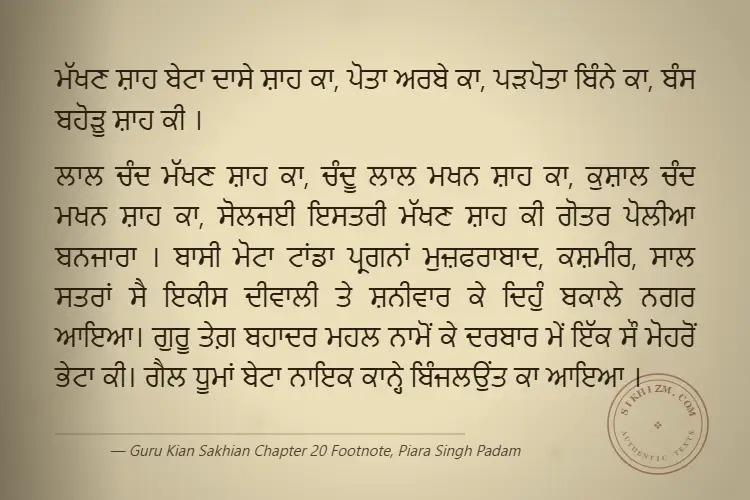 Read Chapter 20 of Guru Kian Sakhian (Original Text) Here
The Devotional Telling: Suraj Prakash's Full Account (Raas 11, Ansh 3–9)
This is the version most people actually grew up hearing — and now that the full text is in hand, it's worth walking through, because it's where nearly every dramatic beat of the popular story actually comes from.
Ansh 3 — the vow. Makhan Shah's ship, deep at sea, is driven into treacherous sands near a desolate island; the crew's efforts fail entirely. In desperation he prays to Guru Nanak's light — invoking Guru Tegh Bahadur Ji by name — and vows 500 gold coins if the ship is freed. It is, through what the text frames as the Guru's unseen intervention, though the crew credits their own labour.
Ansh 4 — arrival and confusion. Reaching Bakala after profitable trading, Makhan Shah learns of Guru Har Krishan Ji's passing and the "Baba Bakale" utterance. He finds twenty-two Sodhi claimants, each with masands pressing his case — Dhir Mal's claim bolstered by his possession of the original Adi Granth volume. Makhan Shah reasons that only the true Guru is truly Antaryami — all-knowing — and resolves to test for that.
Ansh 5 — the test of two gold coins. He devises his method overnight: offer every claimant a token two gold coins, reasoning that an impostor will accept it gladly while the true Guru will recall the full 500-coin vow. He visits Dhir Mal and all twenty-one others in turn; each accepts the two coins, bestows a siropa, and praises him for more. Not one mentions the ship, the storm, or the 500 coins. Makhan Shah returns to his camp disheartened.
Ansh 6 — Mata Nanaki's intervention. Word of Makhan Shah's arrival and his frustration reaches Mata Nanaki Ji. She urges her son, Guru Tegh Bahadur Ji, to step forward and sit publicly. He declines — cautioning that seeking self-declared status invites spiritual ruin — and counsels patience, letting the Divine Will unfold on its own.
Ansh 7 — the meeting. Restless, Makhan Shah spends the night in Gurbani and prayer, then asks whether any other Sodhi descendant lives in Bakala without a public throne. He's told of Tegh Bahadur Ji — living in a small chamber, detached from worldly affairs, largely unknown even by name. Makhan Shah goes to him, bows, and places two coins before him. The Guru smiles and asks: "Why present only two coins when you pledged five hundred during your crisis at sea?" Makhan Shah is overcome — this is the recognition moment.
Ansh 8 — preparing to proclaim. Makhan Shah asks permission to reveal the Guru to the world. Tegh Bahadur Ji cautions him about the burden this will bring — the enmity of the disappointed claimants — but Makhan Shah spends the night preparing fine garments, the full 500 mohars, and karah parshad.
Ansh 9 — "Guru Ladho Re." With Mata Nanaki Ji's blessing, Makhan Shah presents the offerings and requests the Guru appear publicly. Guru Tegh Bahadur Ji accepts. Makhan Shah climbs to the highest rooftop in Bakala and cries out, "Guru Ladho Re! Guru Ladho Re!" — and the Sangat streams toward Guru Tegh Bahadur Ji as the twenty-two thrones empty out.
Gur Partap Suraj Parkash Granth - Raas 11 Ansh 3 to 9 - Read Here
Comparing the Two "Authentic" Traditions — They Don't Even Agree With Each Other
This is the detail that makes the whole historiographical question worth taking seriously: Guru Kian Sakhian and Suraj Prakash are not the same story with different decoration. They disagree on substance.
| Detail | Guru Kian Sakhian (Sakhi 20) | Suraj Prakash (Raas 11) |
|---|---|---|
| The peril | Boat caught in a whirlpool at a river crossing | Ship driven into quicksand at sea during a storm |
| The vow | 100 gold mohars | 500 gold coins |
| Claimants visited | Only Dhir Mal, as an ordinary stop | All twenty-two, as a deliberate test |
| The offering pattern | Same 5 mohars given to Dhir Mal and to Guru Tegh Bahadur Ji — no discrepancy | Two coins offered to every claimant as a calculated test |
| How recognition happens | The Guru names the colour of the pouch and which son carries it — knowledge of a private object | The Guru names the amount of the original vow — 500 coins, not two |
| Mata Nanaki / Mata Bassi's role | Not present in this Sakhi | Actively urges her son to step forward; blesses the final offering |
| Scale of the "test" | No structured test at all | A methodical, one-by-one test of all 22 claimants |
Both traditions agree on the shape — a true vow, a false start with another Sodhi claimant, a decisive act of the Guru's inner knowledge, a rooftop proclamation. But the specific mechanism of recognition is different in each: one turns on a hidden object (the pouch), the other on a hidden number (the vow amount). That's not a minor transcription variance — it's two different traditions independently deciding what "proof of Antaryami" should look like, a full century or more apart, from what appear to be different starting points.
This matters for how the story should be told honestly: the specific test-of-22 that almost every modern retelling repeats is Suraj Prakash's structure, not the earlier Sakhi's. The Sakhi's own version is quieter, involves only one other claimant, and doesn't stage a systematic test at all.
What Suraj Prakash Adds Beyond the Meeting Itself
Sri Gur Pratap Suraj Granth's preceding section (Raas 10, Ansu 55–56 — the close of Guru Har Krishan Ji's Raas) supplies context that neither the Sakhis nor the Bansawalinama dwell on: real length spent on the decay of the masand system before the succession crisis even begins — masands discouraging ordinary Sikhs from reaching the Guru directly, pocketing offerings, running what amount to local franchises of devotion. Its verdict on the twenty-two is blunt: "twenty-two became 'Guru,' delighted, having gained [wealth]" — with a footnote noting they had settled at Bakala from outside, not that they belonged there.
It's also where Mata Nanaki's role first appears — quietly holding her husband Guru Hargobind Sahib's words about Tegh Bahadur through the chaos — a thread that Raas 11 then picks up directly, making her the one who urges her son toward public acknowledgment once Makhan Shah arrives.
What Our Earliest Sources Actually Say — and Where They Disagree With Each Other
This is the part almost no article on this topic engages with honestly — and having three independent near-contemporary-adjacent threads in front of us makes the point sharper than it would be with just one.
The Bhatt Vahis are the closest thing we have to contemporary written record — genealogical and event registers kept by Bhatt clans attending the Guru's court, valued because they were administrative record-keeping by families with a professional stake in getting names, dates, and lineage right, not devotional composition. Dates like 11 August 1664 for an early transfer ceremony, and the Samvat 1721 Bhadon Sudi Dasami tilak date in Guru Kian Sakhian, trace back to this layer. Their real limitation: surviving manuscripts are later copies, compiled and cross-referenced by modern historians largely in the 20th century, and their entries tend toward terse notices of dates and names rather than narrative — meaning vivid story details are rarely what the Vahis themselves preserve.
Guru Kian Sakhian and Bansawalinama, both drawing on Bhatt-Vahi-adjacent material but compiled a century or so after the events, already tell two different institutional stories — a family tilak ceremony versus a Delhi-organised vakil process — that don't reconcile cleanly with each other, let alone with Makhan Shah's account.
Suraj Prakash, composed by Bhai Santokh Singh in the 19th century — nearly two centuries after the events — represents the furthest layer: devotional hagiography, explicitly meant to inspire rather than document. And as the side-by-side comparison above shows, it isn't simply a more decorated version of the Sakhi's account — it changes the peril (sea storm vs. river whirlpool), the vow amount (500 vs. 100), the scale of the test (all twenty-two vs. one visit to Dhir Mal), and the actual mechanism of recognition (a private object's colour vs. a private vow's amount). Two texts, both claiming to describe the same real event, independently constructed different specific proofs of the Guru's omniscience. That's the clearest evidence in this whole dossier that the narrative specifics — as opposed to the bare fact of the event — are the product of storytelling tradition, not shared documentary memory.
What this means for how "true" the story is: the honest position is neither "it's all legend" nor "it happened exactly as told" — and it's more interesting than either. What we can say with real confidence is the skeleton: Tegh Bahadur Ji living quietly at Bakala for years, a genuine succession crisis with multiple claimants, more than one process (family and institutional) working to resolve it, and Makhan Shah's arrival and public proclamation adding a final, decisive public confirmation — a skeleton corroborated, in outline, across every source examined here. What we can't take as documentary fact is any one version's specific dramatic shape — because the two traditions that give us the most detail flatly disagree with each other on exactly the details that make the story vivid. That's not a flaw unique to Sikh historiography — it's the same pattern historians deal with in early Christian hagiography or the Puranic layer of Hindu textual history: a bare set of facts, elaborated independently by successive generations of devoted retelling into fuller — and divergent — stories.
Guru Ladho Re Diwas: Same Old Mela, a Newer Name
It turns out this isn't actually a new observance — it's an old one wearing a newer name.
The event is properly the Jor Mela Baba Bakala, held annually at Gurdwara Baba Bakala Sahib on a fixed date in the Sikh calendar: Sawan Sudi 15 (Purnima) — the same day as Raksha Bandhan, and known in Punjab as Rakhar Punia (ਰੱਖੜ ਪੁੰਨਿਆ). This is a long-established annual gathering, not a recent invention — thousands of devotees have converged on Baba Bakala Sahib on this date for generations to mark Guru Tegh Bahadur Ji's recognition as the ninth Guru.
What does appear to be more recent is the specific label "Guru Ladho Re Diwas" attached to that same mela — a popularized name for an already-old observance, gaining visibility through dedicated societies, gurdwara programs, and social-media coverage under that specific phrase, rather than a name that's been used for centuries. So the underlying celebration is old; the branding you may not have grown up hearing is the newer part.
Because it falls on Sawan Sudi 15 in the Bikrami calendar, the Gregorian date shifts year to year — in 2026 it lands around late August (Bhadon).
Why This Story Still Matters
Strip away the layers of retelling, and what's left is still remarkable: a man who had spent years being dismissed by his own neighbours as "Tegha Kamla" was found — not through any claim he made about himself, but through quiet, tested character, recognised independently by his own family, by institutional process, and by a travelling merchant keeping a private vow. Whatever the exact shape of any single telling, that's the part every source agrees on.
This article draws on Bhatt Vahi–based material preserved in Guru Kian Sakhian and Bansawalinama, alongside the full devotional narrative tradition of Sri Gur Pratap Suraj Granth (Raas 10–11). Where these sources diverge from each other and from the popular story, this piece has tried to note it rather than flatten it.