

Table of Contents
What is Shaheedi Hafta?
Shaheedi Hafta (Martyrdom Week) is the period during the Punjabi month of Poh (mid-December) dedicated to commemorating the supreme sacrifices of the family of Guru Gobind Singh Ji, including his four sons (Sahibzade) and his mother, Mata Gujri Ji
Why Shaheedi Hafta is Observed in December
Shaheedi Hafta (Martyrdom Week) is observed in December because it aligns with the Punjabi month of Poh, during which the supreme sacrifices of the family of Guru Gobind Singh Ji occurred in 1704 AD (1761 Bikrami).
The observation in December commemorates the following specific historical timeline:
- Evacuation of Anandpur Sahib: The Guru and his followers left the fort of Anandpur Sahib on the freezing night of 20 December 1704 (6 Poh). Read More...
- The Battle of Chamkaur: The martyrdom of the two eldest sons, Baba Ajit Singh Ji and Baba Jujhar Singh Ji, took place on the battlefield of Chamkaur on 22 December 1704 (8 Poh).
- Imprisonment in the Cold Tower: After being betrayed and arrested, the two younger sons and Mata Gujri Ji were brought to Sirhind and imprisoned in the Thanda Burj (Cold Tower) on 25 December 1704 (11 Poh), where they endured peak winter conditions without warm clothing or food.
- Martyrdom at Sirhind: The younger Sahibzade, Baba Zorawar Singh Ji and Baba Fateh Singh Ji, were martyred on 27 December 1704 (13 Poh). Mata Gujri Ji also attained martyrdom on this same day. Read More...
Shaheedi Hafta 2025 dates (Day wise timeline)
01
of 0920 December (6 Poh): Departure from Anandpur Sahib
Guru Gobind Singh departed from the fort of Anandpur Sahib on the night of 20 December 1704 (6 Poh, 1761 Bk) following a gruelling siege that had lasted over seven months. The departure was marked by strategic preparations, an atmosphere of deep solemnity, and the immediate betrayal of the enemy forces.
According to the sources, the departure unfolded in the following manner:
Context and Deception of the Enemy
The Mughal and Hill King forces had failed to capture the fort despite the long siege and eventually resorted to deceit. They swore oaths on the Quran and the Cow that they would not harm the Sikhs if the Guru vacated the fort. Though the Guru recognised their treachery, the extreme starvation within the fort—where Sikhs were reduced to eating boiled leaves and bark—led him to finally agree to leave after being urged by his followers. To expose the enemy's falsehood, he first sent out bullock carts filled with waste material covered in silk; the enemy promptly attacked these carts, proving they intended to break their holy oaths.

Final Preparations and Farewell
Before leaving, the Guru ensured that valuable assets did not fall into enemy hands. Expensive items were burnt, historical documents were destroyed, and cannons were submerged in water. In a moment of profound silence, the Guru walked through the streets of Anandpur Sahib one last time, an act described as a final goodbye to the city he had built. He then visited Gurdwara Sis Ganj to offer a final Ardas (prayer) and entrusted the care of the shrine to an Udasi saint named Gurbaksh Singh.
Organisation of the Convoy
The departure commenced at midnight amidst a biting cold winter storm. The convoy was organised into specific groups for safety:
• Mata Sundar Kaur, Mata Sahib Kaur, and Bhai Mani Singh travelled in palanquins.
• The younger Sahibzade, Zorawar Singh and Fateh Singh, were placed under the care of their grandmother, Mata Gujri Ji.
• The Panj Pyare (Five Beloved Ones) and other prominent Sikhs provided leadership and protection for the various groups.
• The Guru commanded the entire party to move toward Kiratpur Sahib in total silence.
The Pursuit and Rearguard Battles
As the Sikhs reached Kiratpur Sahib and moved toward the hills of Nirmohgarh, the enemy forces discarded their oaths and launched a massive attack. To allow the main party to progress, Bhai Udai Singh and fifty valiant Sikhs stayed behind at Shahi Tibbi to fight a sacrificial rearguard action. This allowed the Guru and his family to reach the banks of the Sarsa River, which was in a state of flood due to heavy rains, leading to the eventual separation of the Guru's family.
The departure from Anandpur Sahib was not merely a retreat but a disciplined evacuation that turned into a heroic struggle for survival against an enemy that had abandoned all moral and religious vows
02
of 0921 December (7 Poh): Separation at River Sarsa
The separation at the Sarsa River (Sarsa Nadi 'te Vichora) occurred on the morning of 21 December 1704 (7 Poh, 1761 Bk), following the Guru's departure from Anandpur Sahib. It was a moment of profound tragedy and chaos, caused by a combination of a betrayed peace treaty, a flooded river, and a relentless enemy attack.
Like a mighty tree suddenly struck by a violent, surging flood, the once-unified family and its followers were torn from their roots, their branches scattered in different directions by a relentless current of both water and war.
The event unfolded as follows:
The Atmosphere and the Attack
As the Sikh convoy reached the banks of the Sarsa, the river was in high flood due to heavy rains. It was Amrit Vela (the early morning hours), and despite the imminent danger of the pursuing Mughal and Hill King forces, Guru Gobind Singh Ji ordered the singing of Asa di Var (sacred hymns). The enemy, having discarded their holy oaths of safe passage, launched a sudden and fierce attack from the rear, turning the river crossing into a bloody battlefield.
The Loss of Life and Literature
The crossing was devastating for the Sikhs. Many brave warriors were martyred while holding back the enemy to allow others to cross. Others were swept away by the rapid, freezing currents of the river. Furthermore, a vast amount of precious literature, historical documents, and the "Vidya Sagar" (a great collection of the Guru's writings) were lost to the flooded waters.
The Three-Way Separation
The Guru’s family and followers were scattered into three distinct groups:
1. Guru Gobind Singh Ji and the Elder Sahibzade: Along with approximately 40 to 50 Sikhs, the Guru crossed the river and headed toward the village of Chamkaur.
2. Mata Sundar Kaur Ji, Mata Sahib Kaur Ji, and Bhai Mani Singh: This group was escorted toward Ropar and eventually reached Delhi for safety.
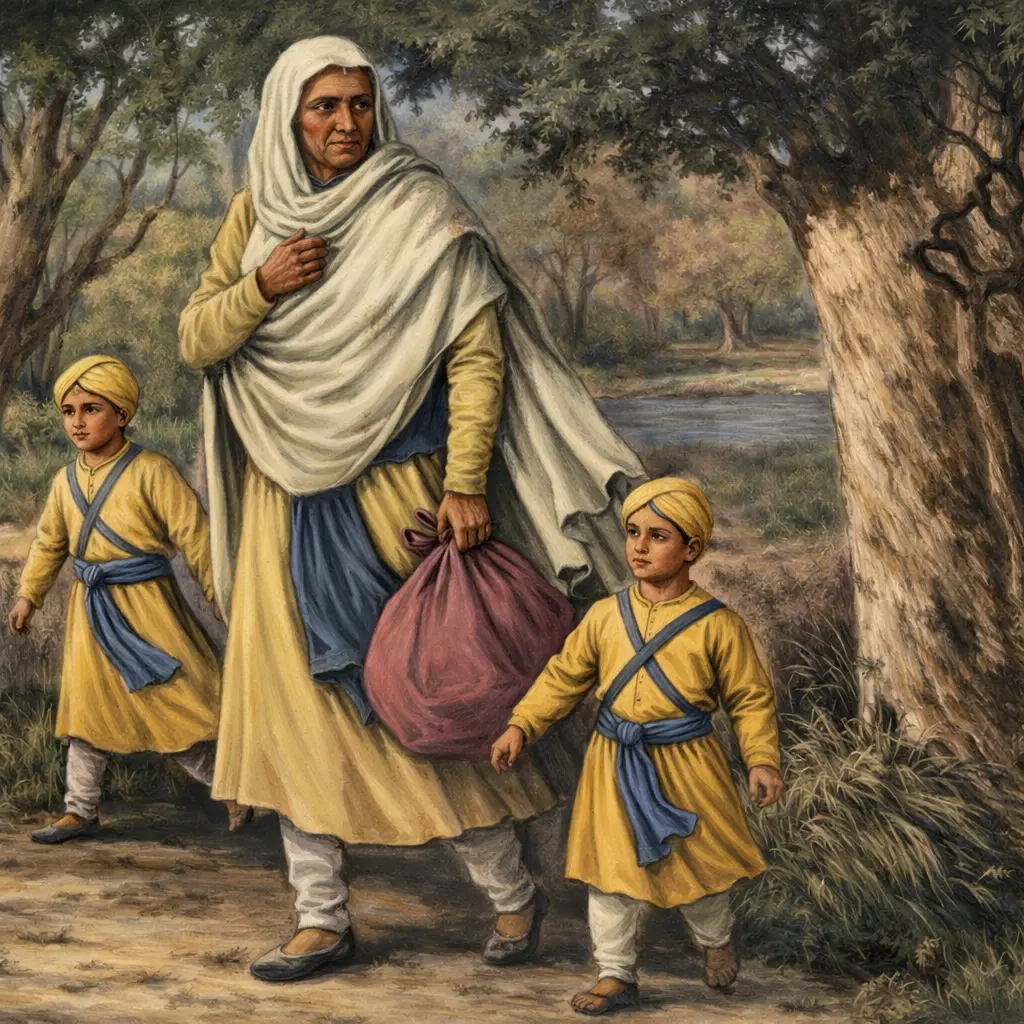
3. Mata Gujri Ji and the Younger Sahibzade: Baba Zorawar Singh (aged 7 to 9) and Baba Fateh Singh (aged 5 to 7) were separated from the main party.
Accompanied by no other servants, they wandered along the riverbank in the biting cold until they were led to a hut belonging to Kumma Mashki, a boatman, where they spent their first night.
The Role of Deceit
This separation was the direct result of the enemy's dishonorable conduct. While the Sikhs were struggling against the natural force of the flooded river, the Mughal generals ignored their previous oaths on the Quran to attack the exhausted and starving convoy.
03
of 0922 December (8 Poh): Shaheedi of Vadde Sahibzade
The martyrdom (Shaheedi) of the Vadde Sahibzade—Baba Ajit Singh Ji and Baba Jujhar Singh Ji—took place during the Battle of Chamkaur on 22 December 1704 (8 Poh, 1761 Bk). After the chaotic separation at the Sarsa River, Guru Gobind Singh Ji, his two eldest sons, and approximately 40 to 50 Sikhs reached a mud-walled house, known as the Kachhi Garhi, in Chamkaur.
The Vadde Sahibzade were like two young lions who, though surrounded by a vast forest of hunters, chose to charge forward with a roar rather than hide, proving that the strength of a spirit dedicated to truth is not measured by its years, but by its courage.
The Siege of Chamkaur
The small mud fortress was surrounded by a massive Mughal and Hill King army, numbering nearly ten lakh (one million). Despite being severely outnumbered, exhausted, and starving, the Sikhs fought with unparalleled bravery, following the Guru's principle of "Sava lakh se ek ladaun" (one shall fight 125,000). The Sikhs left the fort in small groups (Jathas) of five to engage the enemy in hand-to-hand combat.
The Martyrdom of Baba Ajit Singh Ji
- Age and Background: He was the eldest son, born to Mata Sundar Kaur Ji at Paonta Sahib; he was 18 years old at the time of the battle.
- The Request: Seeing the Sikhs attaining martyrdom one by one and the ammunition in the fort running low, Baba Ajit Singh Ji approached his father and asked for permission to go into the battlefield.
- The Battle: The Guru personally armed his son and sent him out with five Sikhs, including Bhai Mohkam Singh (one of the original Panj Pyare). Baba Ajit Singh fought with such ferocity and speed that the enemy forces were thrown into a state of panic.
- Martyrdom: After a valiant struggle, he attained martyrdom before his father’s eyes. Upon seeing his son fall, the Guru did not lament but instead offered a Jaikaar (shout of victory) and thanked the Almighty for returning the "trust" (his son) with honour.
The Martyrdom of Baba Jujhar Singh Ji
- Age and Background: He was the second son, born to Mata Jito Ji at Anandpur Sahib; he was less than 14 years old.
- The Request: After witnessing his elder brother’s heroic end, Baba Jujhar Singh Ji told his father that he too wished to drink the "cup of martyrdom" and follow his brother's path.
- The Battle: Despite his young age, the Guru dressed him in battle regalia and sent him out with five more Sikhs, including Bhai Himmat Singh and Bhai Sahib Singh. He fought with a level of skill that made the enemy believe a much older, seasoned warrior was attacking them.
- Martyrdom: He eventually fell on the same battlefield as his brother, attaining martyrdom in the late afternoon as the sun began to set.
The battle at Chamkaur Garhi serves as a testament to the fact that the strength of the Khalsa is derived from an unshakeable faith and the willingness to sacrifice everything for the sake of justice.
04
of 0923 December (9 Poh): Shaheedi at Chamkaur Garhi
On 9 Poh, 1761 Bk (23 December 1704), Mata Gujri Ji and the two younger Sahibzade, Baba Zorawar Singh and Baba Fateh Singh, reached the village of Saheri to take refuge at the house of their former servant, Gangu. This night is marked in history by a profound act of betrayal that directly led to their eventual capture and martyrdom.
Following events occurred on 9 Poh:
- Arrival at Saheri: After the exhausting separation at the Sarsa River and nights spent in temporary shelters, the family arrived at Gangu's home, believing it to be a safe haven.
- The Theft of Gold: Gangu, driven by extreme greed, noticed the bag of gold coins and jewelry that Mata Gujri Ji carried. During the night, while the family was asleep, he stole the valuables and hid them outside the house to claim them for himself.
- The False Alarm: To conceal his crime, Gangu raised a loud hue and cry, shouting that thieves had entered his home and stolen the Guru's property. When Mata Ji, who had witnessed his actions, gently told him not to worry about the money as long as they were safe, Gangu became defensive and hostile to hide his guilt.
- The Betrayal to Authorities: Fearing that his theft would be discovered or simply seeking a reward from the government, Gangu decided to hand the family over to the Mughal officials. He travelled to Morinda to inform the local administrators, Jani Khan and Mani Khan, about the presence of the Guru’s mother and sons in his house.
The night of 9 Poh was the final night the family spent in a private home before they were arrested the following morning and taken into custody.
05
of 0923 December (10 Poh): Shaheedi of Bibi Sharan Kaur
On 10 Poh, 1761 Bk (24 December 1704), the narrative of the Guru's family and followers followed two distinct and painful paths: the arrest and imprisonment of the younger family members at Morinda, and the final rites of the martyrs at Chamkaur Sahib.
Events unfolded as follows:
Arrest and Betrayal at Saheri
Following Gangu’s betrayal the previous night, the Mughal officials Jani Khan and Mani Khan arrived at Saheri with a guard of soldiers to take Mata Gujri Ji and the younger Sahibzade into custody.
- The Arrest: The family was placed on a bullock cart (bail gaddi) and taken toward Morinda. The scene was heartbreaking, with local villagers watching in shock as the elderly Mata Ji and the two young children were led away under heavy guard.
- Gangu’s Reward: Gangu accompanied the officials to claim his reward. While he was initially given 100 rupees, he complained it was too little; eventually, he was given 200 rupees before returning to his village.
- Imprisonment at Morinda: Upon reaching Morinda, Mata Gujri Ji and the Sahibzade were placed in a small, cold lock-up (havalat). Despite the harsh conditions and the heavy guard, Mata Ji remained steadfast, encouraging the children to remain brave and keep their minds connected to the Divine through Gurbani. They spent the night of 10 Poh in this prison.
Final Rites at Chamkaur Sahib
Simultaneously, at the site of the Battle of Chamkaur, the bodies of the Vadde Sahibzade and the other Sikh martyrs remained on the battlefield.
- The Heroic Cremation: On the night of 10 Poh, Bhai Rama and Bhai Tiloka, two brothers from the village of Jhallian (near Chamkaur), arrived at the scene.
- Disguise and Devotion: To avoid detection by the Mughal patrols, they disguised themselves as madmen or scavengers. Under the cover of darkness, they gathered the remains of the Vadde Sahibzade (Baba Ajit Singh and Baba Jujhar Singh) and the other Sikhs to perform their last rites on a single funeral pyre.
- Bibi Sharan Kaur: Bibi Sharan Kaur ji showed immense courage in assisting with the identification and cremation of the martyrs, an act for which she eventually attained martyrdom herself.
06
of 0924 December (11 Poh): Thanda Burj
On 11 Poh, 1761 Bk (25 December 1704), the narrative of the younger Sahibzade and Mata Gujri Ji shifted from their arrest in Morinda to their arrival and first trial in Sirhind. This day is marked by their arrival at the seat of Mughal power in the region and their initial display of legendary defiance in the face of Nawab Wazir Khan.
Arrival in Sirhind
Early on the morning of 11 Poh, the Mughal guards took Mata Gujri Ji and the younger Sahibzade from the prison in Morinda and transported them to Sirhind in a bullock cart. Upon arrival, they were initially made to sit under a Pipal tree while officials decided where to house them. Eventually, on the orders of Wazir Khan, they were moved to the Thanda Burj (Cold Tower), a high structure designed to remain cool in the summer but which was lethally freezing during the peak of winter.
The First Court Appearance
The Sahibzade were summoned to the court of Nawab Wazir Khan later that day. Key moments of this encounter were:
- The Greeting: As they entered the court, the young Sahibzade did not bow to the Nawab. Instead, they loudly proclaimed the Khalsa greeting: "Waheguru Ji Ka Khalsa, Waheguru Ji Ki Fateh".
- The Temptation: Wazir Khan, along with the courtier Sucha Nand, attempted to lure the children away from their faith. They offered the Sahibzade immense wealth, estates (Jagirs), and high positions in the Mughal administration if they would convert to Islam.
- The Defiance: Despite being only five and seven years old, the children firmly rejected these offers. They stated that they were the sons of Guru Gobind Singh and the grandsons of Guru Tegh Bahadur, and they would never trade their faith for worldly riches.
- Sucha Nand’s Provocation: When Sucha Nand asked what they would do if set free, the Sahibzade boldly replied that they would gather an army, fight against tyranny, and establish a rule of justice.
The Night in the Cold Tower
Following their refusal to convert, the Nawab ordered them back to the Thanda Burj. They were provided with no food, no bedding, and no warm clothing, despite the biting winter winds.
- Mata Ji’s Role: Mata Gujri Ji spent the night of 11 Poh sitting on the cold floor, holding both children in her lap to provide what little warmth she could.
- Spiritual Strength: To keep their spirits high, she narrated stories of the bravery and sacrifices of their ancestors, specifically the martyrdom of their grandfather, Guru Tegh Bahadur. She encouraged them to remain steadfast in their faith, preparing them for the trials that lay ahead.
The day of 11 Poh established the ideological battleground where the physical might of an empire was met with the unyielding spiritual resolve of two young children.
07
of 0926 December (12 Poh): Court of Wazir Khan
On 12 Poh, 1761 Bk (26 December 1704), the younger Sahibzade, Baba Zorawar Singh and Baba Fateh Singh, alongside their grandmother Mata Gujri Ji, faced their final day of trial in the court of Sirhind and spent their last night together in the Thanda Burj (Cold Tower).
The events of this day are among the most poignant in Sikh history:
The Final Court Appearance
The Sahibzade were brought back to the court of Nawab Wazir Khan for the final time. The Nawab and his courtiers, including Sucha Nand, made one last attempt to force them to convert to Islam.
- Refusal to Convert: The children remained unshakeable, stating that they were the progeny of lions and would never abandon their faith for worldly greed. They declared that they preferred death to living under the shadow of a tyrant.
- The Fatwa (Death Sentence): When it became clear that the children could not be swayed, the Qazi (religious judge) pronounced the decree that they be bricked alive (Niaa vich chinne) as a punishment for their "rebellion" against the state.
The "Haa da Naara" (Crying Out for Justice)
Upon hearing the cruel sentence, Nawab Sher Muhammad Khan of Malerkotla stood up in protest. He argued that the children were innocent and that Islamic law did not permit the killing of minors for the perceived crimes of their father. His plea was ignored by Wazir Khan and Sucha Nand, but he famously walked out of the court in protest, an act that is still honoured by Sikhs today.
The Last Night in the Cold Tower
The children were returned to the Thanda Burj to spend the night of 12 Poh, which was their "Aakhri Raat" (Last Night).
- The Service of Bhai Moti Ram Mehra: Despite a strict ban on providing food or water to the prisoners, a devoted Sikh named Bhai Moti Ram Mehra risked his life and the lives of his family to bribe the guards and bring warm milk to the starving Sahibzade and Mata Ji. This act of devotion is memorialised as a supreme service to the Guru's family.
- Mata Ji’s Final Lesson: Mata Gujri Ji spent this final night holding the children in the freezing tower. She prepared them mentally and spiritually for the following morning, telling them that their sacrifice would water the roots of the Khalsa Panth and that they must meet the wall of bricks with a smile.
Atmosphere in Sirhind
While the children remained calm and resolute, the news of the impending execution spread through the city of Sirhind, causing widespread grief and horror among the residents, who viewed the sentence as a grave sin.
08
of 0927 December (13 Poh): Shaheedi of Chhote Sahibzade & Mata Gujri Ji
On 13 Poh, 1761 Bk (27 December 1704), one of the most tragic and heroic chapters in human history took place with the martyrdom (Shaheedi) of the younger Sahibzade, Baba Zorawar Singh Ji and Baba Fateh Singh Ji, along with their grandmother, Mata Gujri Ji. This day is remembered as the ultimate sacrifice for faith and righteousness.
The events of 13 Poh were as follows:
The Martyrdom of the Chote Sahibzade
- The Execution: After several days of trials and their steadfast refusal to convert to Islam, the younger Sahibzade—aged nine and seven—were brought out to be executed on the orders of Nawab Wazir Khan,.
- Bricked Alive: They were made to stand at the execution site where a wall was built around them. Historical records describe them remaining calm and immersed in the Divine name as the bricks rose.
- The Final Act: When the masonry wall reached their chests, the executioners, Shashal Beg and Bashal Beg, martyred the children using a sword. The Sahibzade met their end with the same bravery they had shown throughout their imprisonment.
The Martyrdom of Mata Gujri Ji
- Final Moments in the Tower: Mata Gujri Ji, aged 81, was waiting in the Thanda Burj (Cold Tower) for news of her grandsons,.
- Departure: Upon being informed of their heroic martyrdom, she offered a final Ardas (prayer) to the Almighty, thanking Him for the successful completion of their "trust". She then breathed her last and departed from the physical world while still in the tower.
Historical Significance
Events of 13 Poh shook the foundations of the Mughal Empire. Guru Gobind Singh Ji later remarked that the blood of the innocent martyrs had "uprooted the roots of tyranny," and Sirhind became known to Sikhs as "Guru Maari Sirhind" (the Sirhind cursed by the Guru) because of these cruel acts.
09
of 0928 December (14 Poh): Sanskar
Cremation of Shaheed Baba Zorawar Singh, Fateh Singh and Mata Gujri Ji took place on Poh 14, 1761 Bk (December 28, 1704 CE)
The Service of Diwan Todar Mal
- The Search for Land: Following the executions, the bodies of the martyrs were thrown near the river. Diwan Todar Mal, a wealthy and devoted individual, sought permission to perform their final rites.
- The Most Expensive Land: The Nawab refused to grant land for the cremation unless the area was covered in gold coins (ashrafis) stood on their edges. Todar Mal Ji sacrificed his entire life's wealth, laying out the gold coins to purchase the small plot of land required,. He then performed the last rites of the Sahibzade and Mata Ji with great reverence.
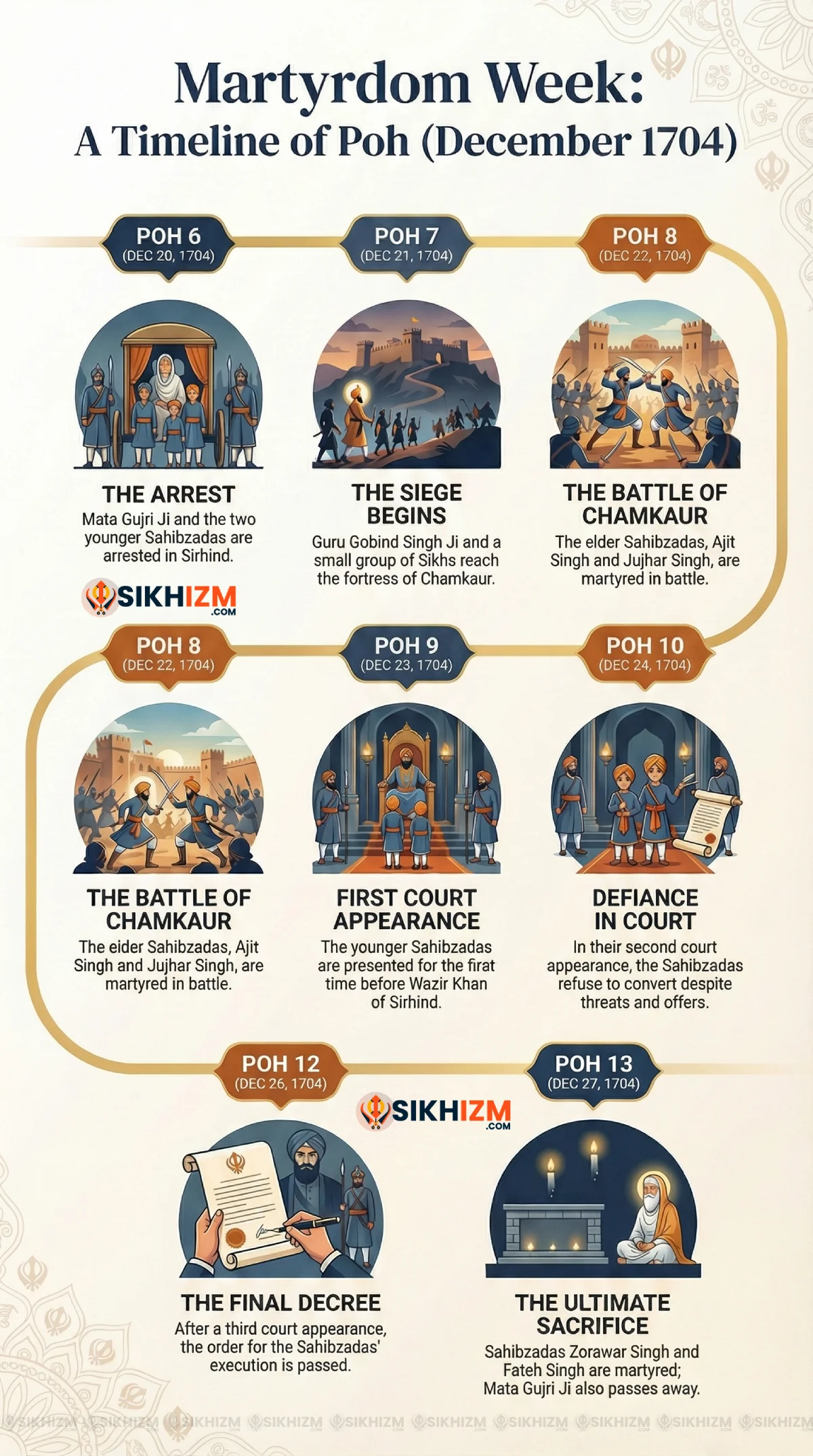
Shaheedi Hafta History Events (Infographic)
Shaheedi Hafta significance
This week, solemnly known as the nights of Poh, commemorates the unparalleled journey of sacrifice undertaken by the family of Guru Gobind Singh Ji. It serves as a profound reminder of Sikh Sidak (unwavering faith), as the Guru's mother and four sons remained steadfast through extreme cold and persecution. The sources suggest that the blood of these innocent martyrs effectively uprooted the foundations of tyranny in the Mughal Empire.
Shaheedi Hafta December 2025
| Date (CE) | Date (Bikrami/Nanakshahi) | Event |
|---|---|---|
| 20 December | 6 Poh | Guru Gobind Singh Ji left Qila Sri Anandpur Sahib along with His family and other Gursikhs. |
| 21 December | 7 Poh | Separation of Guru Gobind Singh Ji’s family at the bank of River Sirsa. |
| 22 December | 8 Poh | Shaheedi (Martyrdom) of Vadde Sahibzade – Baba Ajit Singh Ji and Baba Jujhar Singh Ji. |
| 23 December | 9 Poh | Shaheedi of Singhs in the Battle of Chamkaur Garhi. |
| 24 December | 10 Poh | Shaheedi of Bibi Harsharan Kaur Ji, who performed the cremation of Sahibzade. |
| 25 December | 11 Poh | Chhote Sahibzade and Mata Gujri Ji were brought to Thanda Burj at Sirhind. |
| 26 December | 12 Poh | Chhote Sahibzade were presented before the court of Wazir Khan. |
| 27 December | 13 Poh | Shaheedi of Chhote Sahibzade – Baba Zorawar Singh Ji, Baba Fateh Singh Ji, and Mata Gujri Ji. |
| 28 December | 14 Poh | Cremation (Sanskar) of Shaheed Baba Zorawar Singh Ji, Baba Fateh Singh Ji, and Mata Gujri Ji. |
Veer Bal Diwas 27 December
Observed on 27 December (13 Poh), this day marks the final martyrdom of the two youngest sons of the Tenth Guru. While the specific name "Veer Bal Diwas" is a modern designation set by Government of India (not accepted by whole Sikh Congregation), the historical events of this date represent the peak of courage where five and seven-year-old children chose death over conversion. Their refusal to bow to the Nawab of Sirhind made them a global symbol of bravery for all generations.
Martyrdom of Sahibzade
The four Sahibzade sacrificed their lives in two distinct chapters: the Battle of Chamkaur and the executions at Sirhind. The elder two, Baba Ajit Singh and Baba Jujhar Singh, attained martyrdom on the battlefield, while the younger two, Baba Zorawar Singh and Baba Fateh Singh, were bricked alive and then executed. Their story is unique in world history because of the extreme bravery they displayed at such tender ages.
Shaheedi of Mata Gujri Ji
Mata Gujri Ji attained martyrdom in the Thanda Burj (Cold Tower) of Sirhind at the age of 81. She spent her final days preparing her young grandsons for their sacrifice by narrating the history of their ancestors' bravery. Upon being informed that the children had successfully upheld their faith and attained martyrdom, she offered a prayer and breathed her last in the tower.
Sikh Shaheedi December events: Aftermath
Following events unfolded in the days following the martyrdom:
1. The News Reaches Guru Gobind Singh Ji
The sources state that Guru Gobind Singh Ji received the full account of the martyrdom of the younger Sahibzade and Mata Gujri Ji while he was staying at the village of Lamma-Jatpura.
- The Messenger: A man named Noora Mahi, who had been sent from Raikot to Sirhind to gather information, brought the news.
- The Guru’s Reaction: Upon hearing the tragic details, the Guru remained completely composed and resolute. At that moment, he was using his arrow to uproot a small weed (Kahi) from the ground.
- The Prophecy: He declared that just as he had uprooted that small plant, the roots of the tyrannical Mughal Empire had been uprooted by the blood of the innocent Sahibzade. He thanked the Almighty that his "trust" (his children) had been returned with honour.
2. The Fate of Gangu
The miserable end of the servant Gangu, who had betrayed the family for gold.
- The Search for Treasure: After the children were executed, the Mughal officials pressured Gangu to hand over the bag of gold coins and jewelry he had stolen.
- The Deceit Unravels: Gangu had hidden the treasure in a dry stream bed, but a sudden surge of water (or his own inability to find the spot) meant the money could not be recovered.
- A "Dog's Death": Believing he was lying and keeping the wealth for himself, the Mughal officials beat and tortured Gangu to death. The sources describe this as a "dog's death" and a divine punishment for his treachery.
3. The Legacy of "Guru Maari Sirhind"
Following the events of the martyrdom, the city of Sirhind gained a lasting reputation among Sikhs.
- The Curse: Because of the cold-blooded execution of the young children, Guru Gobind Singh Ji referred to the city as "Guru Maari Sirhind" (the Sirhind cursed by the Guru).
- Historical Rite: The sources mention that for generations, Sikhs visiting the area would carry away bricks or debris from the city and throw them into the river (Sutlej) as a sign of their rejection of the tyranny that occurred there.
4. Safety of the Guru's Wives
While the younger Sahibzade were being martyred, the Guru’s wives, Mata Sundar Kaur and Mata Sahib Kaur, were escorted to Delhi by Bhai Mani Singh and other Sikhs. They reached safety and eventually reunited with the Guru much later at Talwandi Sabo (Damdama Sahib), where they were informed of the children's supreme sacrifice.