

Table of Contents
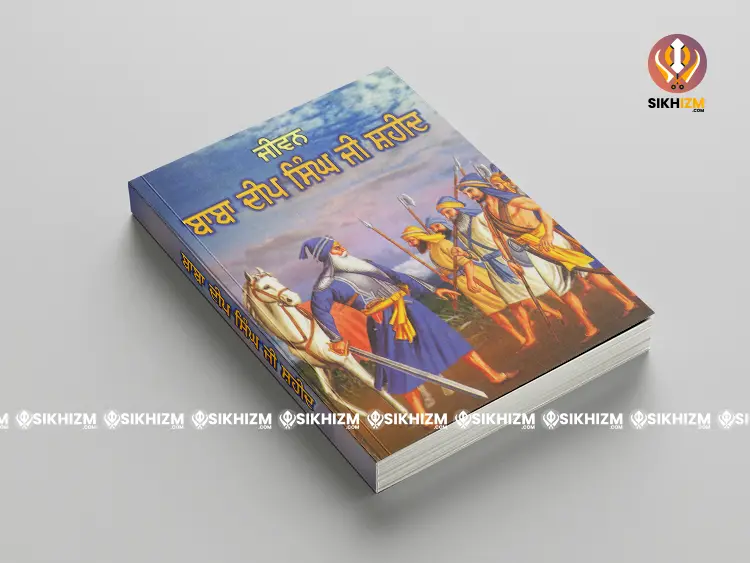
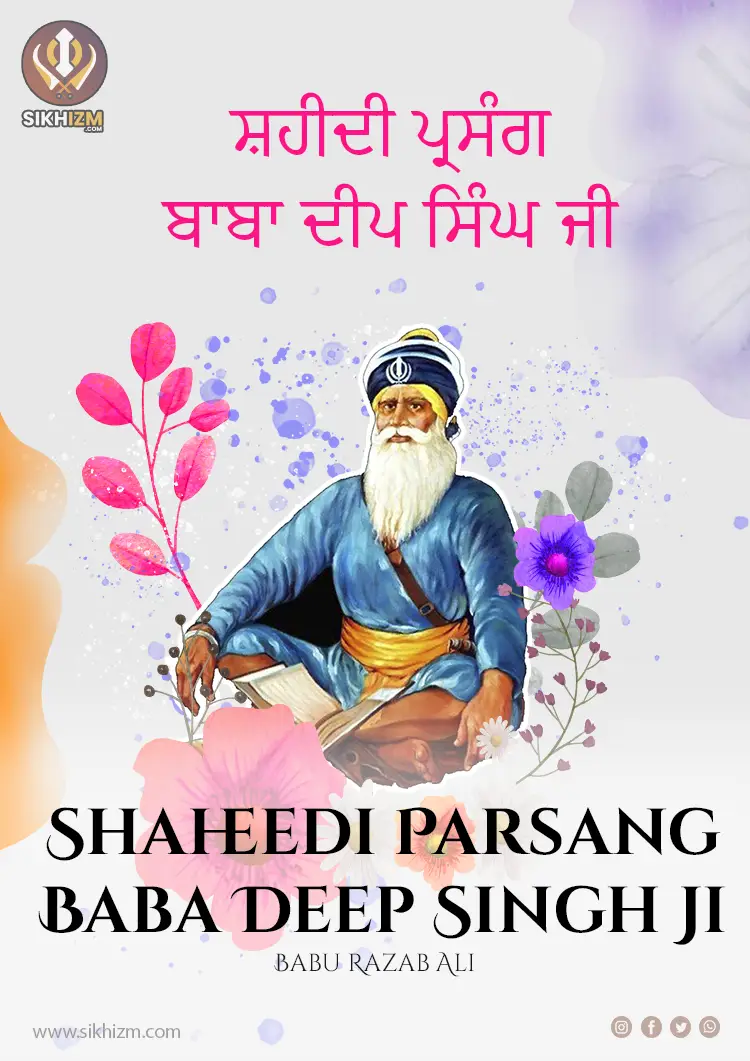
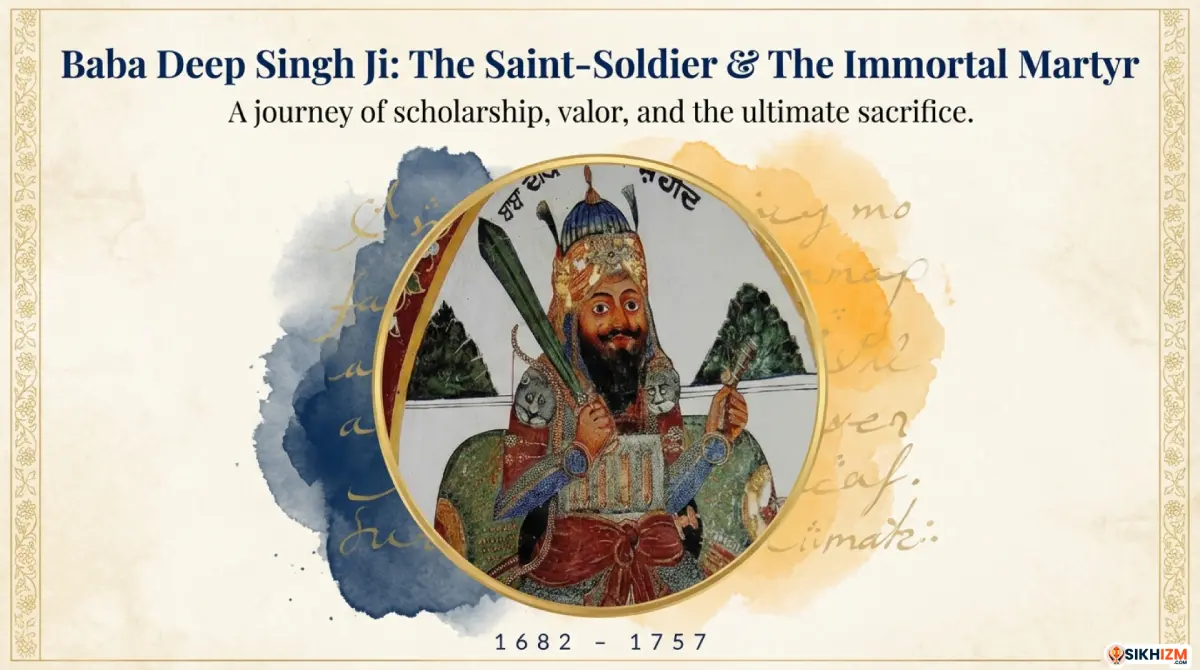
Baba Deep Singh Ji stands as one of the most revered figures in Sikh history, embodying the ideal of the "Sant-Sipahi" or Saint-Soldier. His life is an unparalleled saga of devotion, scholarly excellence, and a level of bravery that transcends the physical limits of mortality. Known for his miraculous feat of fighting even after his head was severed, Baba Deep Singh Ji represents the indomitable spirit of the Khalsa.
| Full Name | Baba Deep Singh Ji Shaheed |
| Mother | Mata Jeoni Ji |
| Father | Bhai Bhagta Ji |
| Date of Birth | 14 Maagh, Sambat 1739 Bikrami (January 27, 1682) |
| Place of Birth | Village Pahuwind, District Sri Tarn Taran Sahib, Punjab |
| Martyrdom | 30 Kattak, Sambat 1814 Bikrami (November 11, 1757) |
01
of 15Baba Deep Singh: Early Life and Birth Heritage
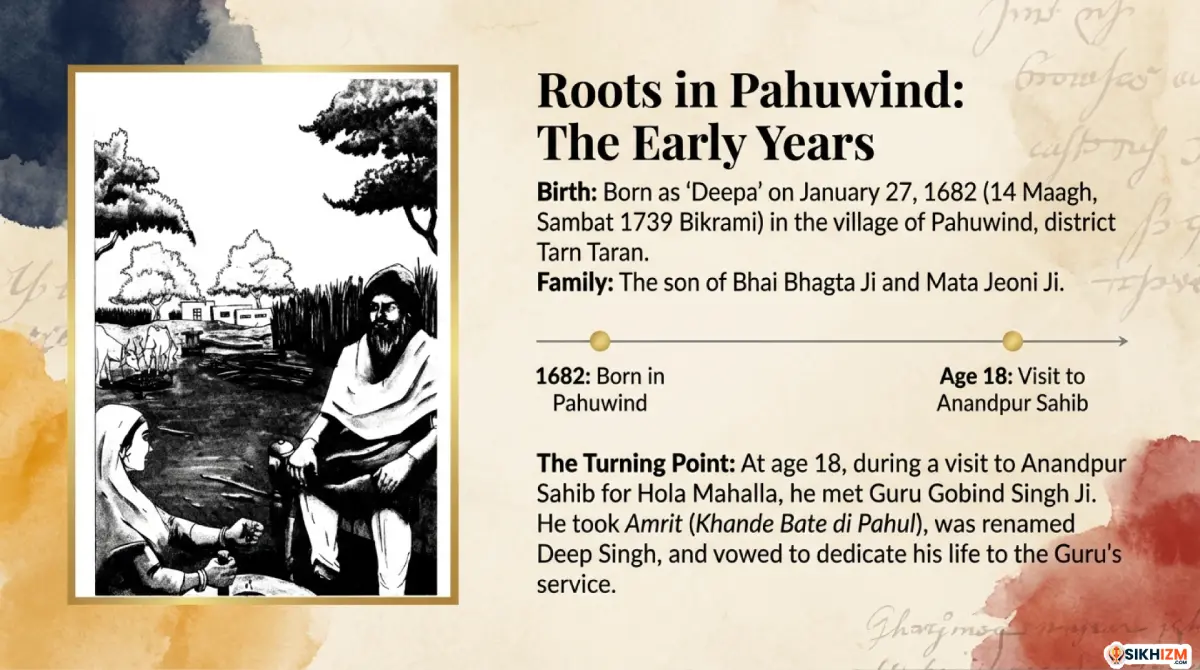
Baba Deep Singh Ji was born on January 27, 1682 (14 Maagh, Sambat 1739 Bikrami), in the village of Pahuwind, located in the Amritsar district of Punjab. He was born into a devoted Sikh family; his father was Bhai Bhagta Ji and his mother was Mata Jeoni Ji. During his childhood, he was affectionately named Deepa by his parents. From a young age, he was immersed in a spiritual environment, though the full trajectory of his life would change when his family decided to visit the Guru.
02
of 15Transformation at Anandpur Sahib
At the age of approximately 18, in the year 1700 (some sources suggest around the time of the 1699 Vaisakhi), Deepa traveled with his parents to Anandpur Sahib to visit Guru Gobind Singh Ji. This period was pivotal in Sikh history, following the creation of the Khalsa Panth. Deepa was deeply moved by the Guru’s presence and requested to be initiated into the new order. He received Khande Bate di Pahul (Amrit initiation) directly from the hands of the tenth Guru and was renamed Deep Singh.
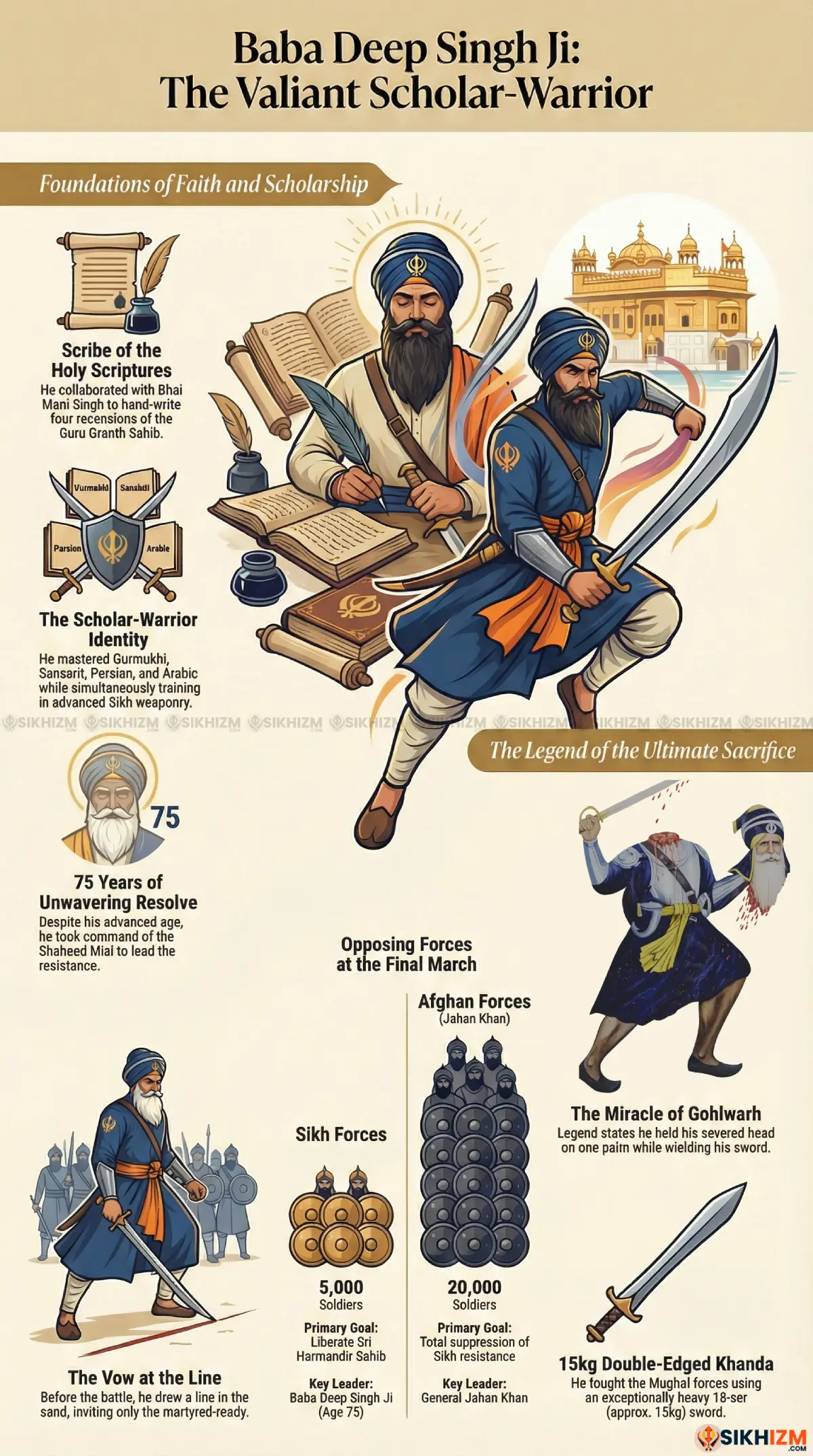
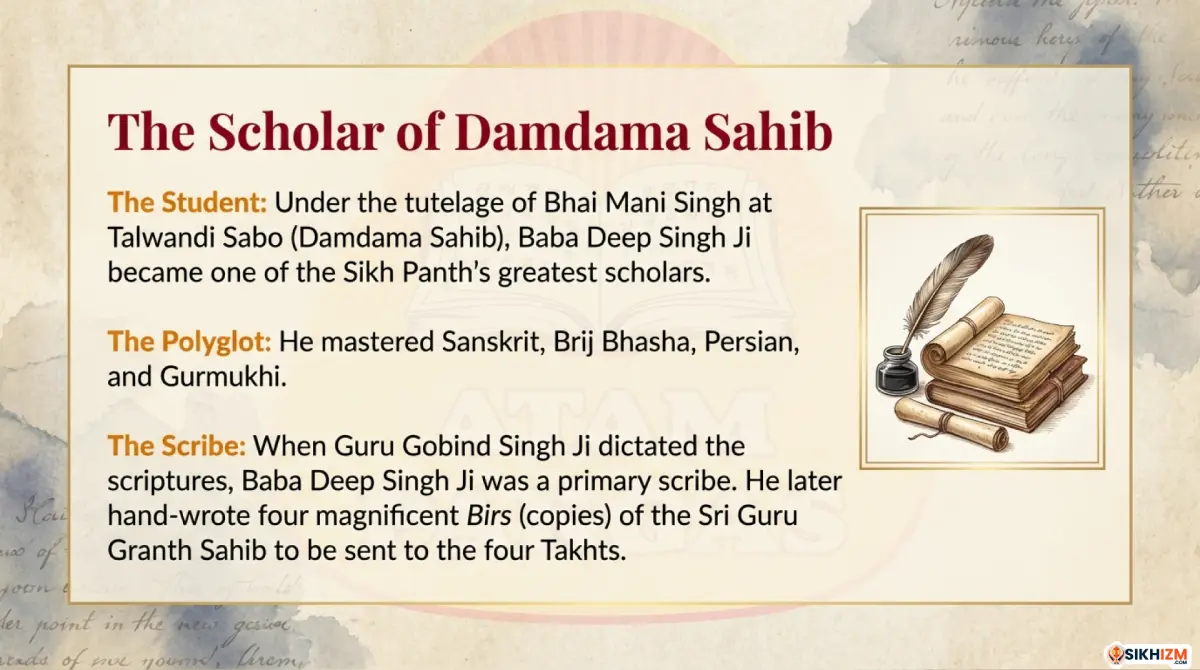
While his parents eventually returned to their village, Baba Deep Singh Ji chose to stay at Anandpur Sahib to serve the Guru. It was here that he began his dual education in spiritual wisdom and martial arts. Under the guidance of the great scholar Bhai Mani Singh Ji, he mastered several languages, including Sanskrit, Brij, Persian, and Gurmukhi. Simultaneously, he received rigorous training in weaponry, archery, and horsemanship, becoming a master of the Khanda (double-edged sword).
03
of 15The Scholarly Contributions at Damdama Sahib
Baba Deep Singh Ji was not only a formidable warrior but also a profound scholar. After the evacuation of Anandpur Sahib and the subsequent battles, he reunited with Guru Gobind Singh Ji at Talwandi Sabo (now known as Damdama Sahib) in 1705.
At Damdama Sahib, the Guru dictated the final version of the Guru Granth Sahib, which included the hymns of the ninth Guru, Guru Teg Bahadur Ji. Baba Deep Singh Ji, alongside Bhai Mani Singh Ji, played a crucial role in scribing these handwritten recensions, known as the Damdami Beerhs. He worked tirelessly to produce four main copies of the holy scripture, which were then sent to the different Sikh Takhts (seats of authority). His dedication to the preservation of Gurbani led to the establishment of the Damdami Taksal, the premier Sikh school of learning and scriptural interpretation, where he served as the first head. He remained at Damdama Sahib for many years, from roughly 1726 to 1757, focusing on preaching the faith and teaching the correct recitation of Gurbani.
04
of 15Warrior for the First Khalsa Raj
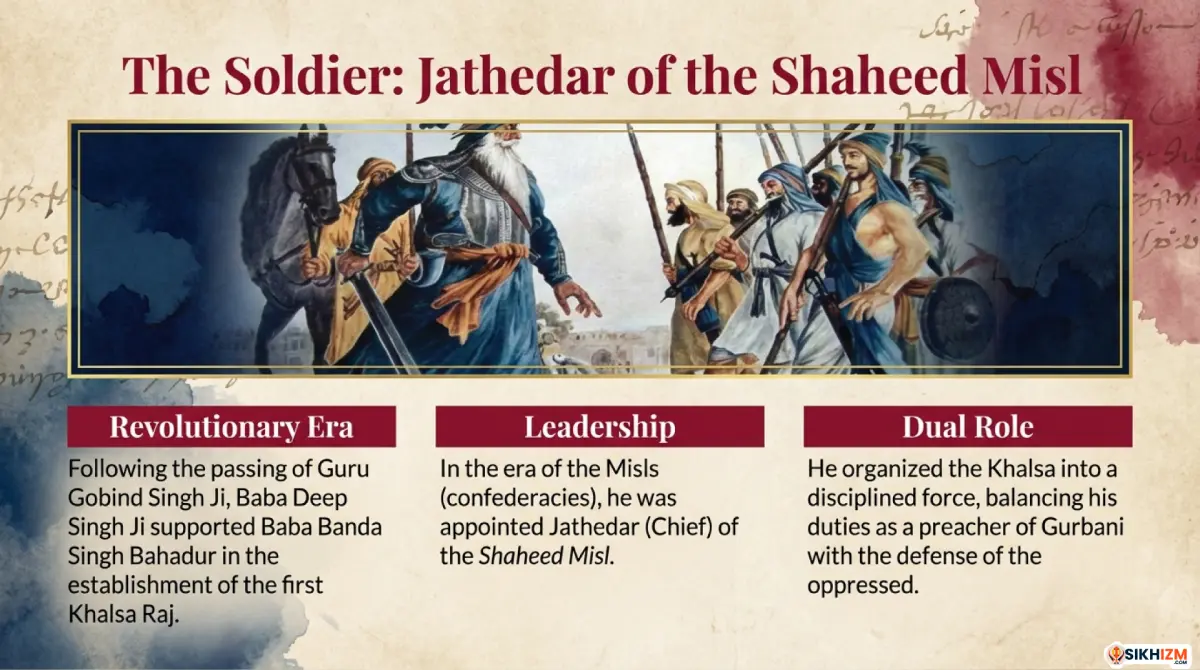
Following the passing of Guru Gobind Singh Ji, the leadership of the Sikh struggle was taken up by Baba Banda Singh Bahadur. Baba Deep Singh Ji joined forces with him, providing both spiritual guidance and military strength. He participated in several key battles aimed at dismantling the oppressive Mughal administration and establishing the first Khalsa Raj.
His military prowess and leadership qualities were later formalised when the Sikh community was organised into Misls (military sovereign states). Baba Deep Singh Ji was appointed the first Jathedar (chief) of the Shaheedan Misl, a group known for its members' willingness to embrace martyrdom for the sake of righteousness.
05
of 15The Invasions of Ahmed Shah Abdali
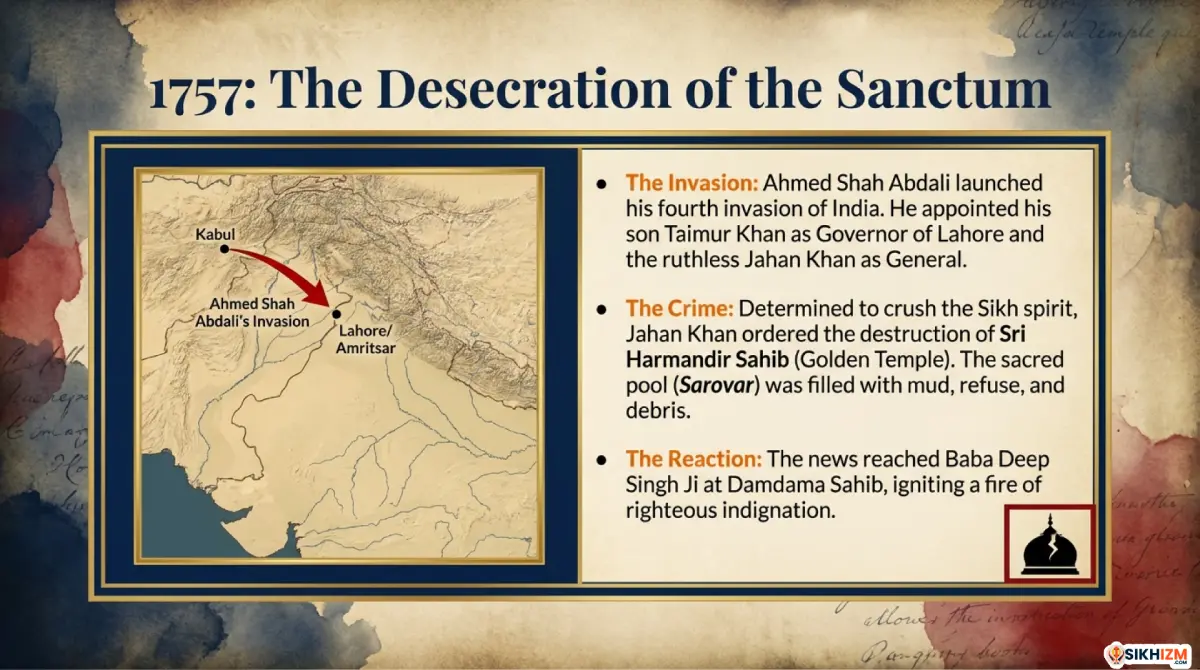
The mid-18th century was a period of great turmoil in Punjab due to the repeated invasions of the Afghan ruler Ahmed Shah Abdali. Abdali’s forces frequently looted Indian cities and took thousands of people, particularly women, as captives to be sold as slaves in Afghanistan. The Sikhs, under leaders like Baba Deep Singh Ji and Jassa Singh Ahluwalia, initiated a system known as the Rakhi system to protect the local population from these marauders.
In 1756, during his fourth invasion, Abdali carried away immense wealth and thousands of captives. Baba Deep Singh Ji led a daring attack on the Afghan columns, successfully liberating many captives and returning them to their homes. This act of humanitarianism further incensed the Afghan authorities.
06
of 15The Sacrilege of Sri Darbar Sahib
The conflict reached a breaking point when Abdali’s son, Taimur Shah, and his general, Jahan Khan, decided to strike at the heart of the Sikh faith—Sri Harmandir Sahib (The Golden Temple) in Amritsar. In 1757, Jahan Khan’s forces invaded Amritsar, destroyed parts of the city, and committed the ultimate sacrilege by filling the sacred Sarovar (pool) with dirt, debris, and the carcasses of animals to humiliate the Sikhs.
News of this desecration reached Baba Deep Singh Ji while he was at Damdama Sahib. Despite being 75 years old, he was filled with righteous indignation and immediately vowed to liberate the holy shrine or die in the attempt. He issued a call to the Khalsa, declaring that the time had come to "marry the bride of death" for the sake of the Guru's house.
07
of 15The Vow of Baba Deep Singh and the Line at Tarn Taran
As Baba Deep Singh Ji marched from Damdama Sahib toward Amritsar, his small band of followers grew into a formidable force of 5,000 Sikhs. Upon reaching Tarn Taran Sahib, located about 10 miles from Amritsar, Baba Ji performed Ardas (a formal prayer) and drew a line on the ground with his sword.
He addressed the gathered warriors, stating that only those who were prepared for certain martyrdom and would never turn their backs on the battlefield should cross the line. In a display of absolute commitment, every single Sikh present crossed the line, signaling their readiness to sacrifice their lives for the sanctity of the Golden Temple. This historic spot is now commemorated by Gurdwara Lakir Sahib.
08
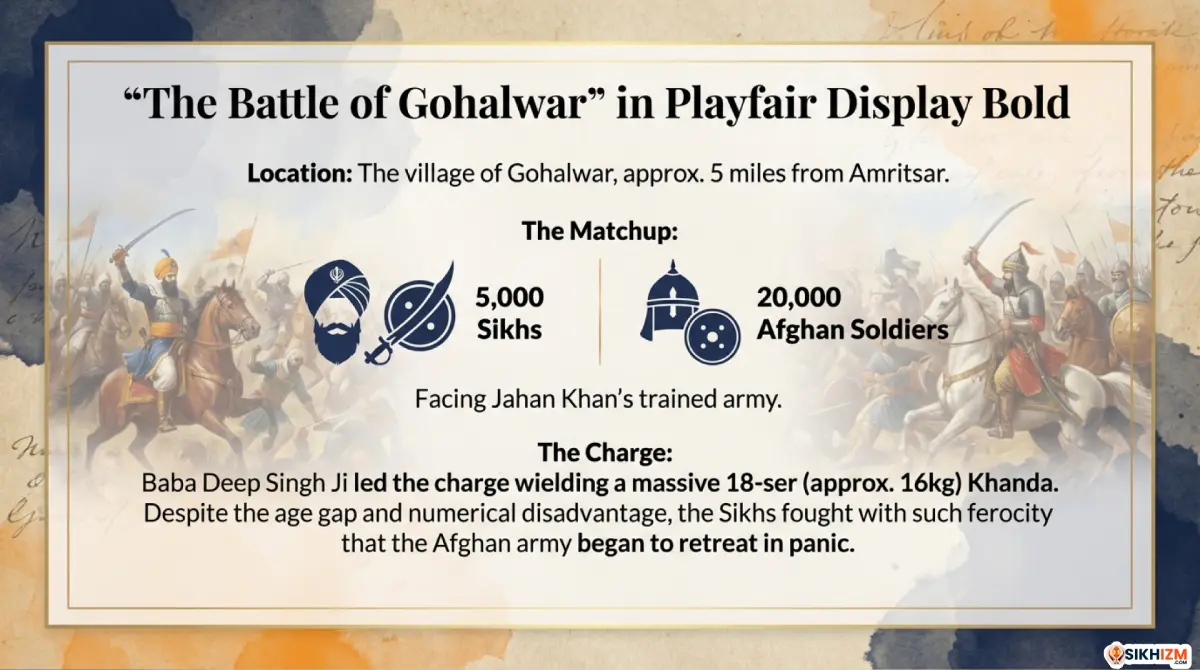
of 15The Battle of Gohlwarh
The Afghan general Jahan Khan, hearing of the Sikh advance, mobilized a force of 20,000 soldiers to intercept them. The two armies clashed at the village of Gohlwarh, roughly halfway between Tarn Taran and Amritsar. Despite being outnumbered four-to-one, the Sikhs fought with a ferocity that stunned the Afghan regulars.
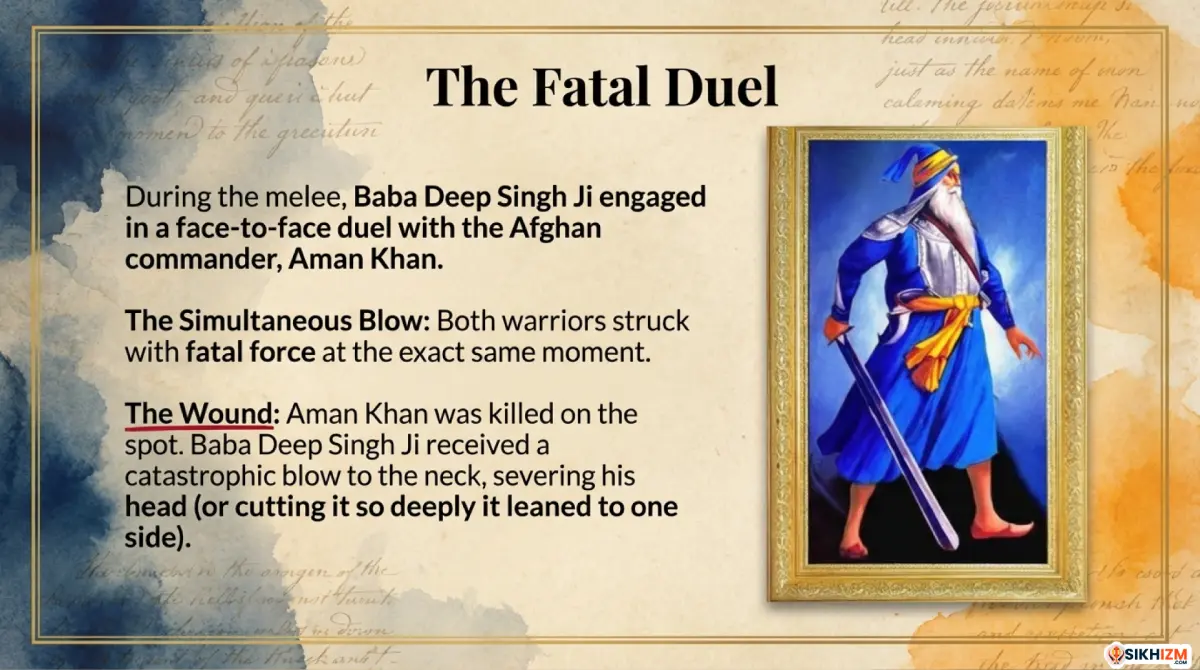
Baba Deep Singh Ji was seen at the center of the fray, wielding an 18-ser Khanda (a sword weighing approximately 15 kilograms). He cut through the enemy ranks with relentless strength, heading toward the Golden Temple. During the intense hand-to-hand combat, a fierce duel took place between Baba Deep Singh Ji and an Afghan commander, Amaan Khan. In a moment of simultaneous impact, both warriors struck each other with such force that both their heads were severed from their bodies. Amaan Khan fell dead instantly.
09
of 15The Miraculous Martyrdom of Baba Deep Singh Ji
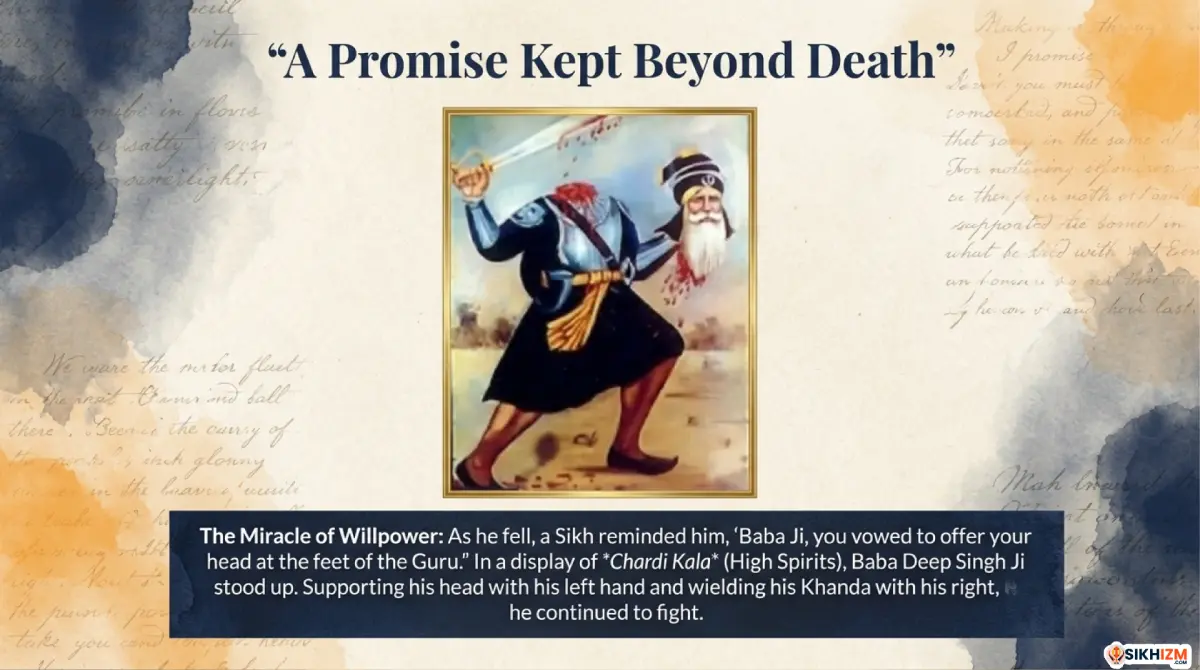
What followed is one of the most celebrated miracles in Sikh history. As Baba Ji’s head fell, a fellow Sikh reminded him of his vow: "You promised to reach the Golden Temple; yet here you fall midway".
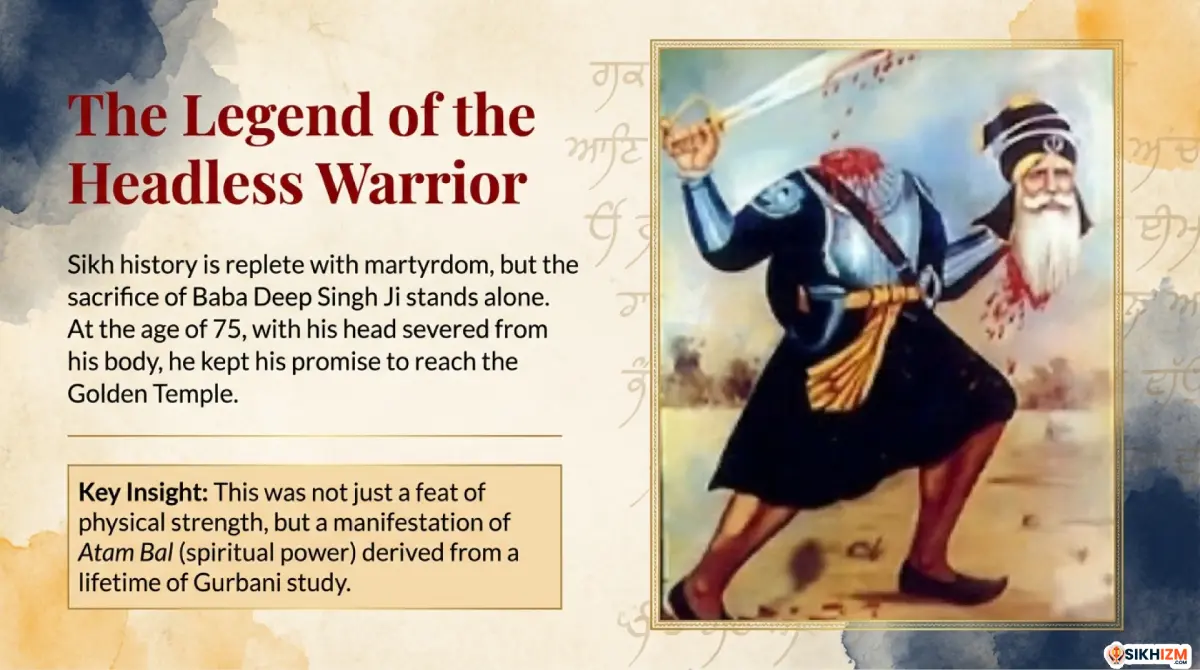
Infused with a spiritual power derived from his lifelong devotion to Gurbani, Baba Deep Singh Ji rose back up. He picked up his severed head with his left hand, supported it on his palm, and continued to swing his Khanda with his right hand, carving a path through the terrified Afghan army. The sight of a headless warrior fighting with such vigor struck terror into the hearts of the enemy, who began to flee, believing they were facing a supernatural force.
10
of 15The Final Offering at the Golden Temple
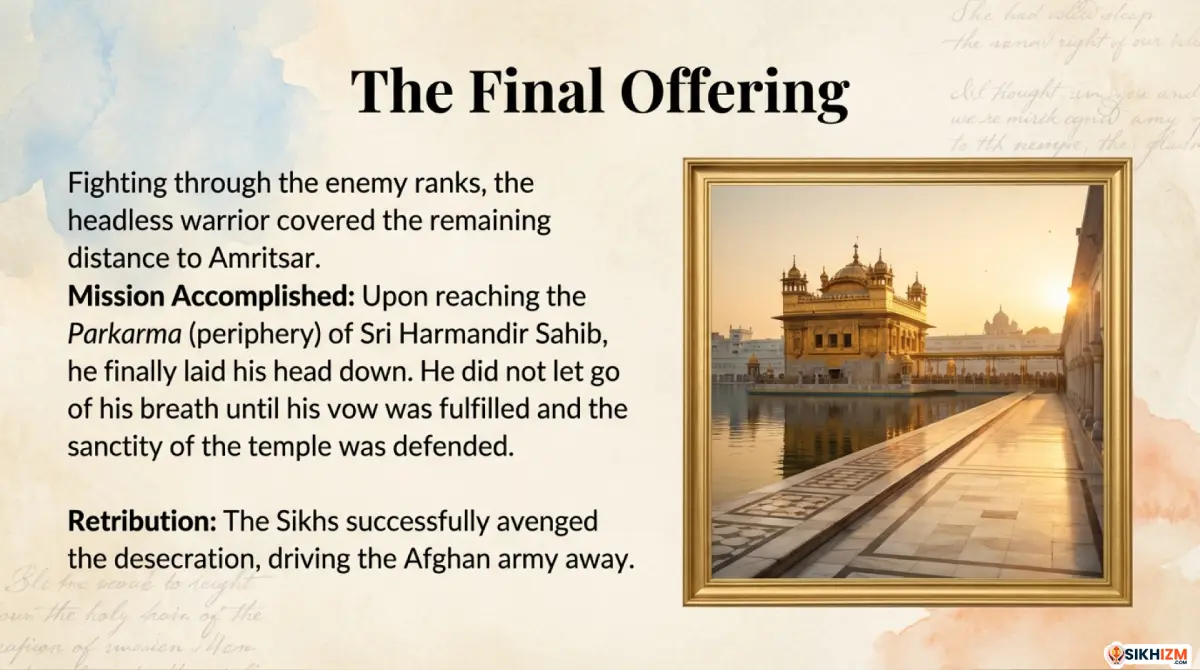
Baba Deep Singh Ji successfully fought his way across the remaining miles to the periphery of the Golden Temple. Upon reaching the Parikarma (the circumambulatory path surrounding the temple), he fulfilled his vow by laying his head on the sacred marble floor as an offering to the Guru. Only then did his body finally come to rest.
This extraordinary act of devotion occurred on November 11, 1757. He had proved that for a true Gursikh, physical death is secondary to the fulfillment of one’s duty and oath to the Guru.
11
of 15Spiritual Legacy and Commemoration
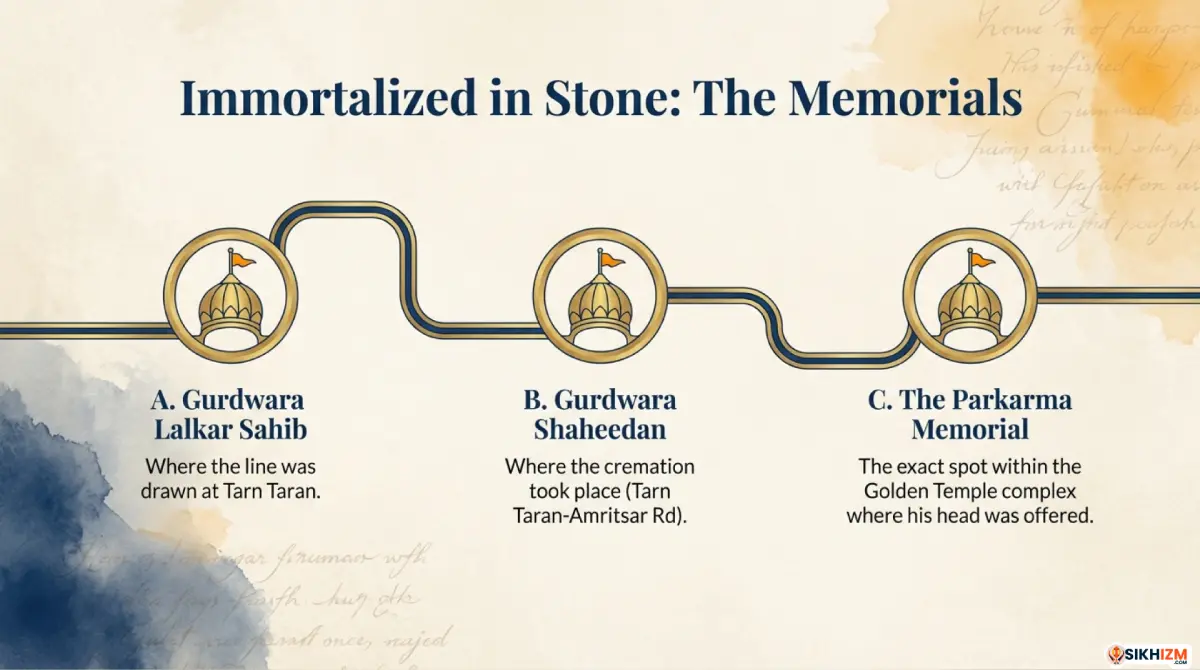
The martyrdom of Baba Deep Singh Ji serves as a cornerstone of Sikh identity, teaching that the defense of religious freedom and the sanctity of holy places is worth any sacrifice. Several shrines mark the path of his final journey:
- Gurdwara Lakir Sahib: Marks the spot in Tarn Taran where he drew the line in the sand.
- Gurdwara Lalkar Sahib: Located at the site of the main battle (Adarsh Nagar,Tarn Taran) in Gohlwarh.
- Gurdwara Shaheed Ganj (Amritsar): Located near the Golden Temple, marking the site where he and his fellow martyrs were cremated.
- A special marker within the Parikarma of Sri Harmandir Sahib marks the exact spot where he finally laid down his head.
12
of 15The Moral Lessons of Baba Deep Singh's Life
The life of Baba Deep Singh Ji offers profound lessons for modern generations. He demonstrated that age is no barrier to serving a higher cause, taking up the sword at 75 to defend his faith. His life was a perfect balance of the intellectual and the martial; he spent decades copying scriptures and teaching before dying on the battlefield.
Furthermore, his actions against Abdali’s forces highlighted a commitment to universal human rights, as he liberated captives regardless of their religion—whether Hindu, Muslim, or Sikh—driven solely by the principle of "welfare for all" (Sarbat da Bhala). Today, his memory continues to inspire millions to remain steadfast in their faith, dedicated to Gurbani, and ready to stand against oppression in any form.
13
of 15Life Story of Baba Deep Singh Ji in Infographics


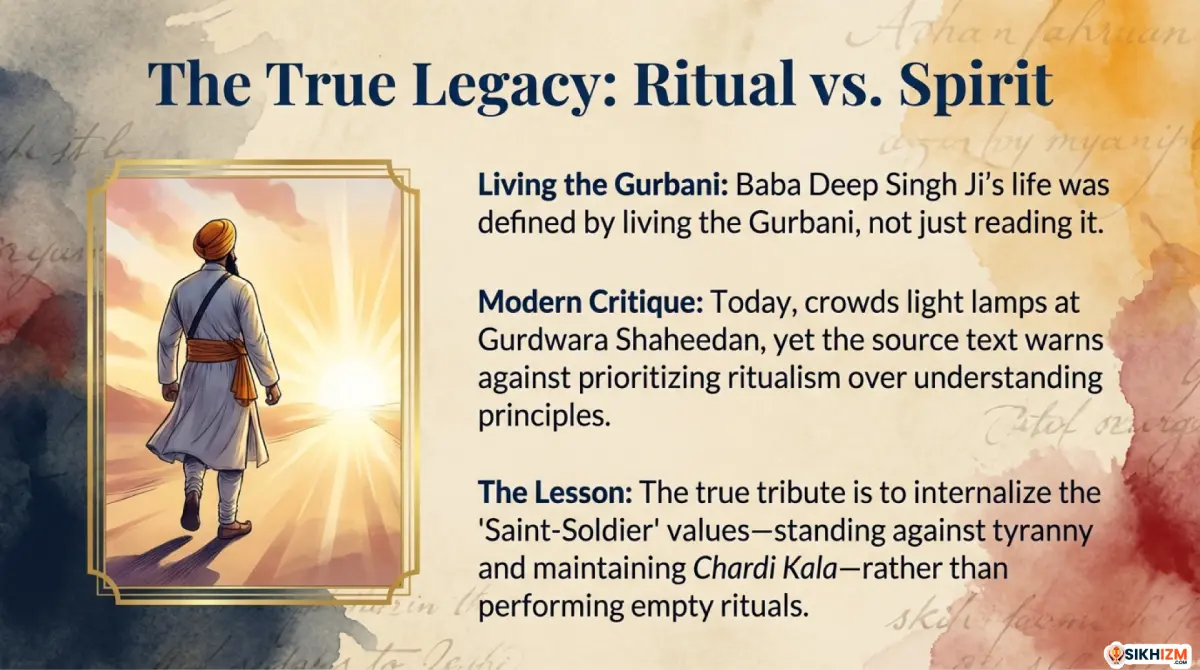
Download the above infographics in PDF Format here.