
Table of Contents
In the summer of 1922, on a dusty stretch of road near a small gurdwara outside Amritsar, thousands of Sikh men and women walked — unarmed, hands folded, chanting "Waheguru, Waheguru" — straight into the wooden clubs of British police. They did not run. They did not strike back. Batch after batch, day after day, for nearly three months, they absorbed the blows and kept walking. What unfolded at Gurdwara Guru Ka Bagh between August and November 1922 became one of the most extraordinary chapters of India's freedom struggle and one of the purest expressions of Sikh ahimsa (non-violent resistance) in modern history.
Known in Punjabi as ਗੁਰੂ ਕੇ ਬਾਗ਼ ਦਾ ਮੋਰਚਾ (Morcha Guru Ka Bagh), this was not simply a local land dispute — it was the flashpoint of the larger Gurdwara Reform Movement, a campaign led by the newly formed Shiromani Gurdwara Parbandhak Committee (SGPC) and the Akali Dal to free historic Sikh shrines from the control of corrupt, British-backed hereditary custodians called mahants. At the centre of the storm stood Mahant Sundar Das, the mahant of Guru Ka Bagh, and on the other side, British officials such as Deputy Commissioner Mr. Dunnett, Superintendent of Police Mr. Macpherson, and the notorious Additional Superintendent of Police Mr. Beaty, whose brutality would later draw international condemnation.
The Morcha also drew the attention of towering national figures — the Christian missionary and Gandhi associate Rev. C.F. Andrews, Congress leader Pandit Madan Mohan Malviya, and even Pandit Motilal Nehru, who, after witnessing the discipline of the Akali volunteers, famously declared them "the finest people that have ever inhabited any part of the world." This article traces the complete, documented history of the Guru Ka Bagh Morcha — its roots, its brutal timeline, its martyrs, and its lasting legacy on the Sikh community and India's freedom movement.
01
of 05Historical Background: Why the Dispute Arose at Guru Ka Bagh
The Sacred Roots of Gurdwara Guru Ka Bagh
Gurdwara Guru Ka Bagh stands about 25 km from Sri Amritsar, on the road connecting Ajnala to Fatehgarh Churian, between the villages of Bhukhewali and Mahisar (Sainsra). The site is sanctified by the visits of two Sikh Gurus. Guru Arjan Dev Ji rested here while travelling between villages, blessing the spot with his presence, and it was here that he is remembered for freeing a local figure, Raja Hari Sen, from a web of jealousy and conspiracy that threatened his life. Later, Guru Tegh Bahadur Ji also visited the site — travelling from the village of Bhukhewali at the request of the local sangat, accompanied by Bhai Lal Chand.
Originally referred to as "Guru Ki Rounh" (the Guru's grazing ground/orchard), the site earned its lasting name — Guru Ka Bagh ("the Guru's Garden") — after Guru Tegh Bahadur Ji instructed the local sangat to plant a garden in the area. During the era of Sikh sovereignty (the Khalsa Raj), Sardar Nahar Singh Chimni built a proper gurdwara building at the site, and later Sardar Punjab Singh, a kumedan (commandant) from Khatra Kalan, endowed the shrine with a substantial jagir (land grant) and appointed a mahant to manage it.
The Corruption of the Mahant System
Like many historic gurdwaras across Punjab, Guru Ka Bagh fell victim to the broader decline that plagued Sikh shrines once wealthy land grants attached themselves to them. A succession of mahants managed the property and its endowment, and — as with so many other shrines of the period — the position gradually became hereditary, complacent, and in several cases, openly corrupt. Historical accounts note that as early as 1873, one mahant even invited a lecturer named Saraphu Ram to preach ideas hostile to core Sikh principles at the gurdwara itself.
Following the death of Mahant Bishan Das, his disciple Mahant Sundar Das took charge of Guru Ka Bagh. Sundar Das's personal conduct — reportedly including improper relationships with women, contrary to the terms under which he held the position — became a source of scandal, and by 1920–21, the wider Gurdwara Prabandh Sudhar Lehar (Gurdwara Reform Movement) had turned its attention to Guru Ka Bagh.
The SGPC Takes Over — and the Mahant Backtracks
On 31 January 1921, a jatha (organised group) led by S. Kartar Singh Jhabbar and S. Dan Singh Vachhoa arrived at Guru Ka Bagh and took charge of the shrine on behalf of the newly formed SGPC. Faced with the reformers, Mahant Sundar Das agreed to a settlement: he would continue as caretaker, but strictly under the supervision of an SGPC-appointed local committee (headed by S. Dan Singh Vachhoa, with S. Inder Singh as secretary). He signed a written undertaking to this effect and, on 8 February 1921, took Amrit (Sikh initiation) at Sri Akal Takht Sahib, adopting the name Joginder Singh.
But the peaceful, negotiated success of the Gurdwara Reform Movement alarmed the British colonial administration, which viewed the SGPC's growing authority as a political threat. Encouraged — historical accounts strongly suggest — by British officials keen to find a pretext to crack down on the Akali movement, the mahant reneged on his commitment. He quietly began reasserting personal ownership over the gurdwara's land, setting the stage for direct confrontation.
The Spark: Cutting Wood for the Langar
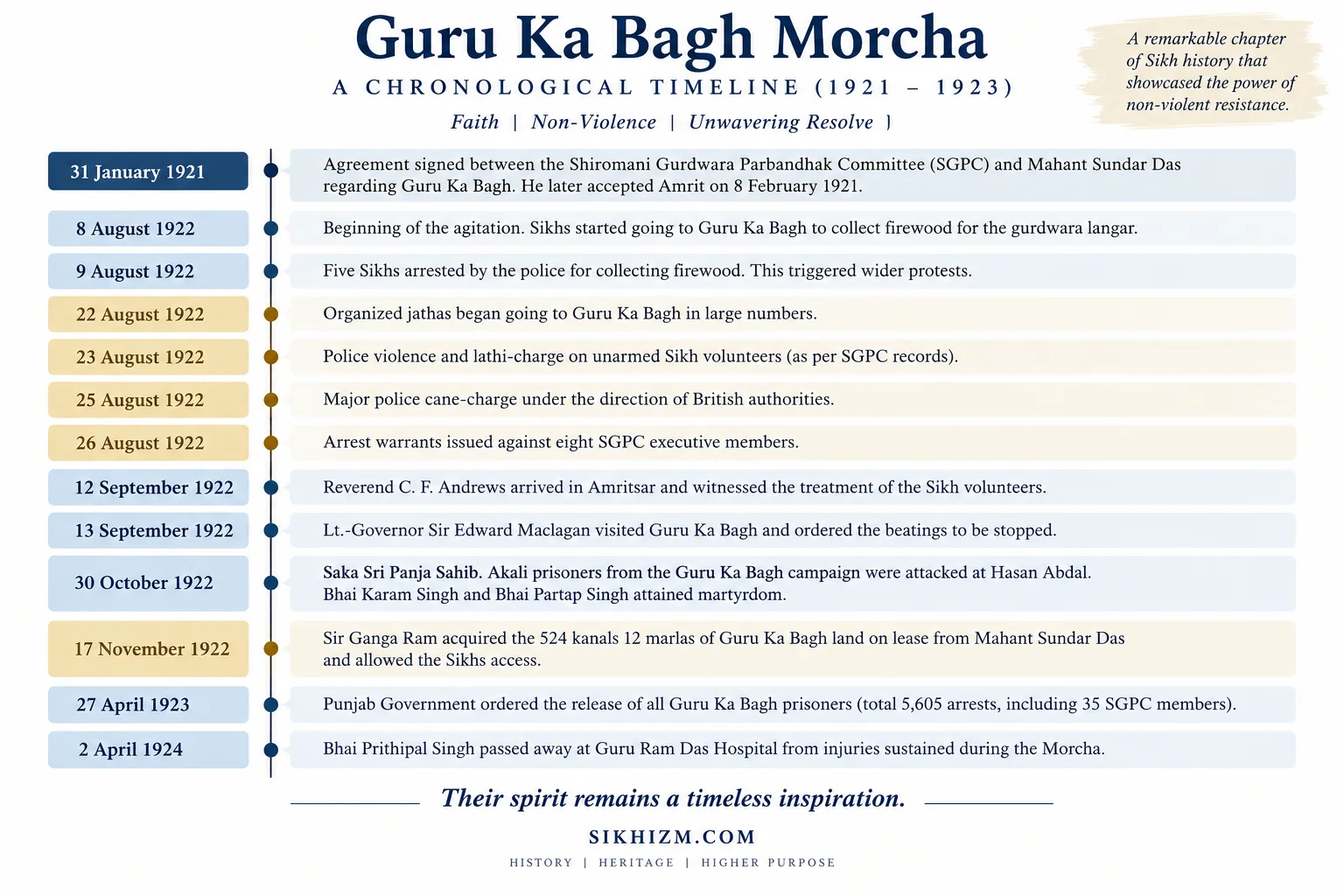
The immediate trigger was almost mundane. As was routine practice for the langar (community kitchen), gurdwara volunteers periodically trimmed branches from kikar (acacia) trees growing on gurdwara land to use as fuel. On 8 August 1922, five sewadars did exactly this — cutting wood in the ordinary course of temple management.
This time, however, Mahant Sundar Das treated it as an act of theft against his personal property. On his complaint, the Deputy Commissioner of Amritsar, Mr. Dunnett, had the local lambardar, Chaudhary Basant Lal, register a criminal case. On 9 August 1922, all five sewadars were arrested under charges equivalent to theft. On 10 August, five more Sikhs — including Bhai Santokh Singh (Laskari Nangal), Bhai Labh Singh (Raja Sansi), Bhai Labh Singh (Manje Nangal), and Bhai Santa Singh (Mesa) — were arrested and swiftly sentenced by a magistrate to imprisonment and fines.
The disputed land itself measured roughly 524 kanals and 12 marlas — originally donated to the gurdwara by the Sikhs of Sainsra village, with Mahant Sundar Das merely a tenant-cultivator (kabzadar) since 1892. As the rightful managing body, the SGPC's position was that cutting wood from gurdwara land for gurdwara langar could not possibly constitute theft. But for the British administration, the "theft" charge was simply a convenient legal cover to suppress the Akali movement's momentum.
02
of 05Key Events & Timeline of the Morcha
The Decision to Resist (20–22 August 1922)
News of the arrests reached the Sikh community immediately. From 20 to 22 August 1922, a three-day diwan (religious assembly) was held at Manji Sahib, Sri Amritsar, where speaker after speaker condemned the government's action. The sangat resolved that jathas of Sikh volunteers would continue, deliberately and openly, to go to Guru Ka Bagh and cut wood — fully aware that arrest and violence awaited them. This was satyagraha in its purest form: a conscious, disciplined courting of arrest to expose injustice.
22 August 1922 — The Beatings Begin
Tuesday, 22 August 1922, is remembered as the day the Morcha truly began in its violent form. Police started arresting Sikh volunteers who arrived to cut wood; 60 Sikhs were taken into custody that day alone. The next day, 23 August, Additional Superintendent of Police Mr. Beaty and Magistrate Mr. Ewan Jenkins entered the gurdwara itself and arrested Bhai Nidhan Singh and four companions, sentencing them to a fine and one year's imprisonment each. By 24 August, the number of arrests had climbed to 180.
25 August–14 September 1922 — Systematic Police Brutality
The Deputy Commissioner, acting on instructions from higher authorities, ordered a policy of "sakhti" (strict force) against the Akali jathas. From 25 August, this translated into outright, systematic beatings of unarmed, unresisting volunteers — a phase that continued relentlessly until 14 September 1922. On the very first day of this policy, 30 Sikhs were seriously injured.
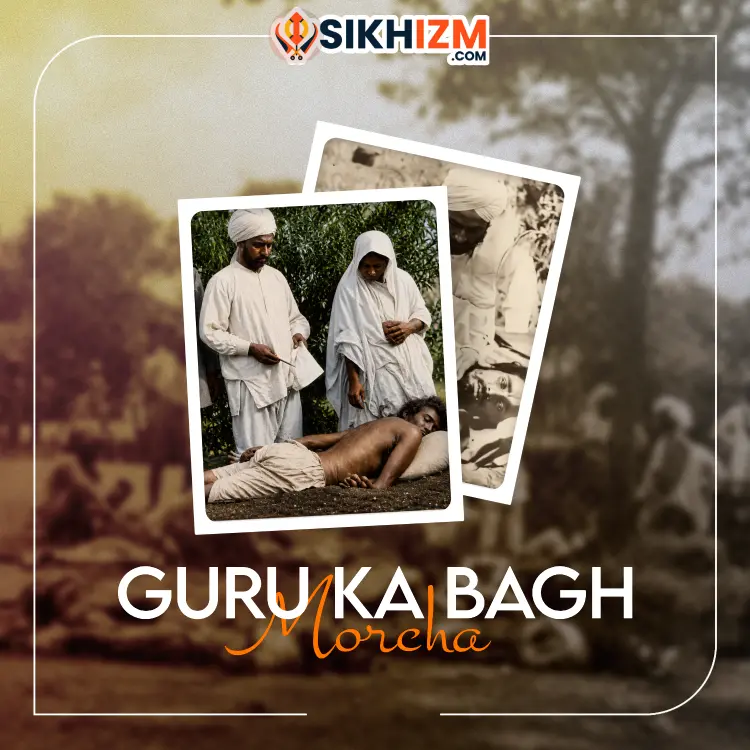
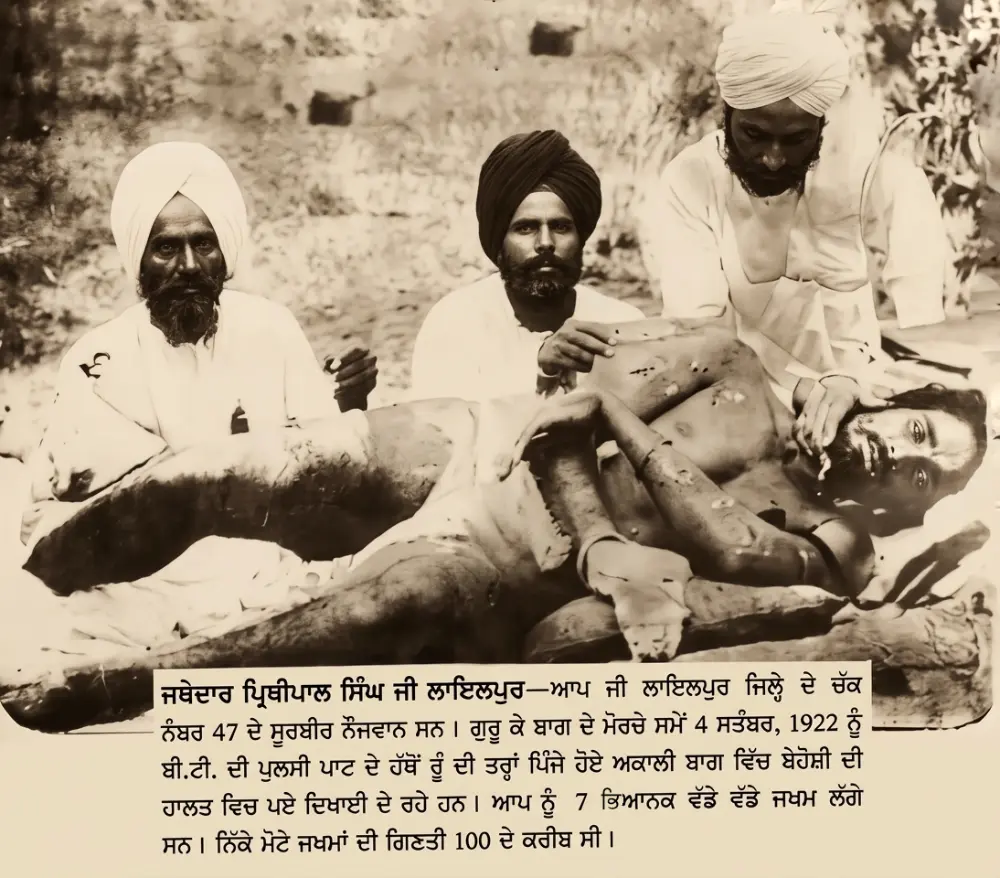
Eyewitness and survivor accounts describe scenes almost impossible to imagine: volunteers walking calmly toward armed police, hands folded or arms crossed, chanting the Sikh formula of remembrance, while constables struck them with iron-shod danda (clubs), tore their hair and turbans, and left the wounded lying in open fields overnight. Two of the earliest and most tragic losses were Sardar Bhagat Singh of village Tera Khurd and his own grandson, Bhai Tara Singh, who were beaten to death together. Jathedar Tehal Singh of Nikki Sarhali was struck in the face with shoes and dragged by his hair. Jathedar Prithipal Singh (also known as Jarnail Singh), leading the Zira–Lalilpur jatha, was beaten with metal-tipped clubs even as he continued to organise resistance.
26 August 1922 — Arrest of the SGPC Leadership
In a major escalation, police arrested the entire top leadership of the SGPC and Akali Dal at Sri Akal Takht Sahib on 26 August — eight senior leaders including Sardar Bahadur Mehtab Singh (President, SGPC), Bhagat Jaswant Singh, barrister S. Narain Singh, Prof. Sahib Singh, S. Sarmukh Singh Jhabal (President, Akali Dal), Master Tara Singh, S. Ravel Singh, and S. Tena Singh Chuharkana. After this mass arrest, Jathedar Tena Singh Samundri took charge of coordinating the movement.
Villages Rally in Support
Even as the crackdown intensified, the neighbouring villages of Sainsra, Bhukhewali, Laskari Nangal, Jagdev Kalan, and Manu Nangal organised themselves into a relay support network — a "farli jatha" — that kept food and water flowing to the volunteers, at real risk of police retaliation. One especially poignant episode involved Bibi Labh Kaur, an elderly widow of Adliwal village (whose husband, Bhai Arjan Singh, had already been martyred), who was shot while trying to bring water to the wounded on her head; she survived and was taken to hospital in Amritsar.
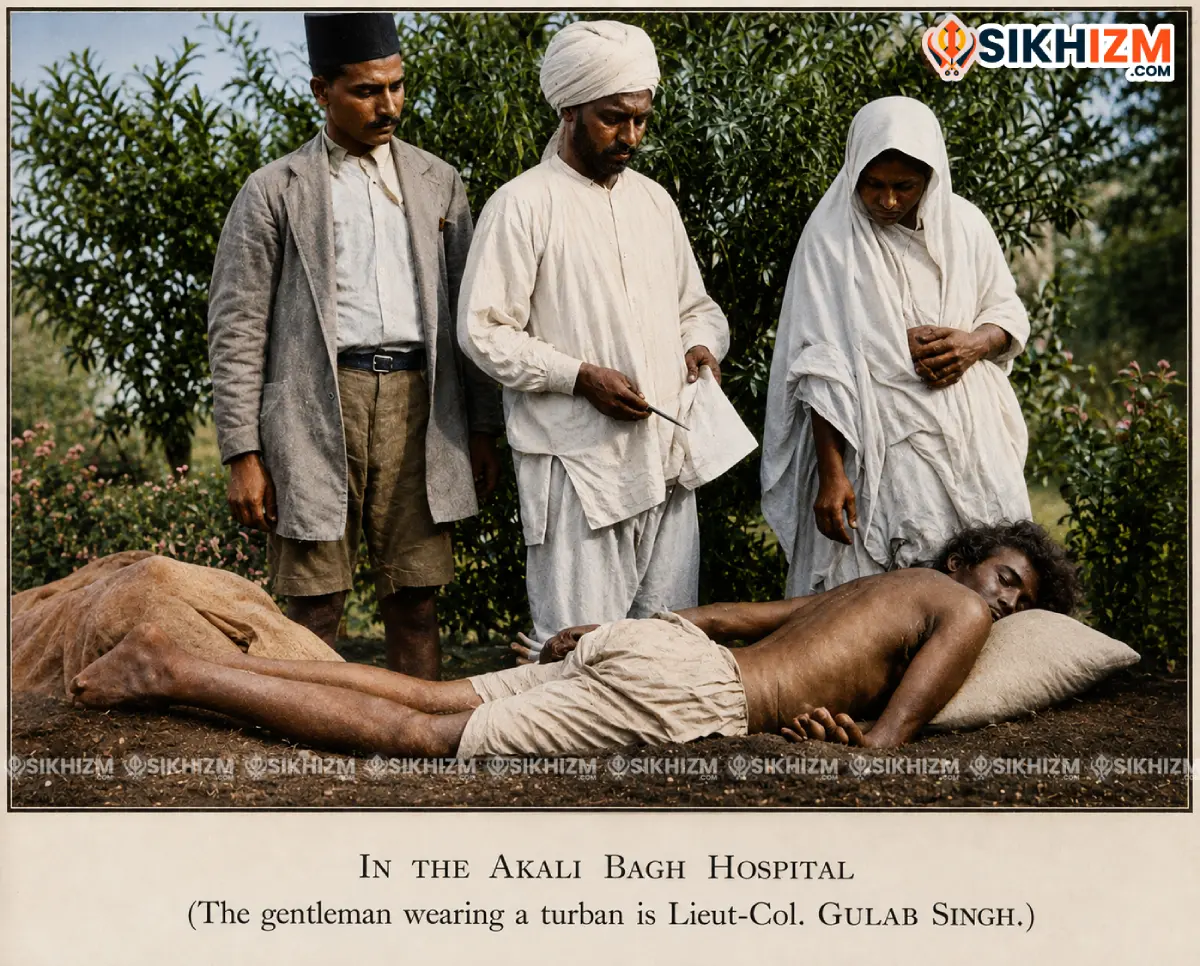
The SGPC set up field hospitals at "Akali Bagh" and at Guru Ka Bagh itself in Amritsar, staffed by roughly 20 volunteer doctors, 10 pharmacists, and 30 trained nurses, supported by an ambulance corps of doctors from Lahore. The city of Amritsar mobilised generously to support the wounded.
3 September 1922 — National Leaders Witness the Morcha
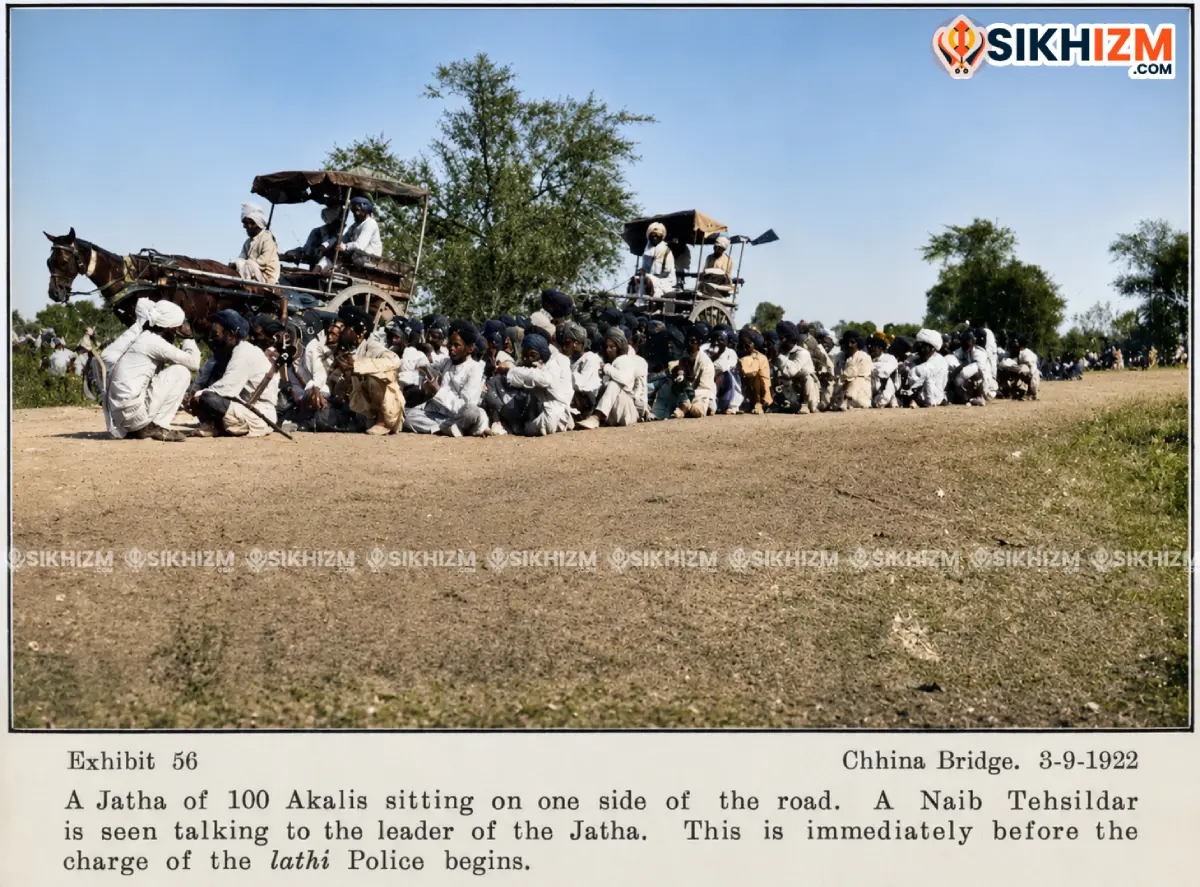
Word of the atrocities spread nationally, drawing prominent public figures to Guru Ka Bagh to witness events firsthand. On 3 September 1922, a jatha departed Akal Takht accompanied by roughly 2,000 spectators, including Pandit Madan Mohan Malviya, Khilafat Committee leader Maulana Muhammad Ali, Mian Muhammad Shafi, and Dr. Saifuddin Kitchlew, who watched the beatings unfold from their cars. Sikh accounts from that day describe a golden falcon (baaz) repeatedly seen circling above the gurdwara and flying toward Sri Darbar Sahib, Amritsar — widely interpreted by the sangat as a symbol of Guru Gobind Singh Ji's own hunting-hawk emblem, and taken as a spiritual sign strengthening their resolve. Professor Ruchi Ram Sahni, a firsthand chronicler of the Morcha, recorded this episode among his testimonies.
Press Censorship
As word spread internationally, journalists, photographers, and public figures began travelling to Guru Ka Bagh from across India and abroad. From 9 September onward, many were stopped at police checkpoints en route and turned back. The British administration went further, banning the circulation of photographs, films, and printed literature documenting the Morcha — an early instance of colonial information suppression aimed at limiting international embarrassment.
12–14 September 1922 — Rev. C.F. Andrews Intervenes
The turning point came when Rev. C.F. Andrews, an English clergyman, educator, and close associate of Mahatma Gandhi, visited the wounded in hospital on 12 September 1922 and was deeply shaken by what he saw. He immediately raised the matter with the Governor of Punjab, telling him plainly that he had witnessed hundreds of innocent, unarmed Sikhs being beaten. On 14 September (Thursday), the Governor personally travelled to Guru Ka Bagh to see conditions for himself, then met officials in Amritsar and ordered an end to the physical beatings.
14 September–17 November 1922 — The Shift to Mass Arrests
With repression by violence failing to break the movement — and now drawing damaging international attention — the government shifted strategy toward mass arrest without physical assault. From 14 September to 17 November 1922, daily jathas continued to leave Akal Takht for Guru Ka Bagh, where volunteers were arrested, their turbans removed, and their belongings searched, but beatings largely ceased. Some episodes of harassment did continue, however — one jatha leader, Jathedar Narain Singh of village Gajj, was forcibly silenced mid-prayer by police as he was being arrested.
By 12 October 1922, roughly 700 Akali prisoners were transferred to Attock jail; the train carrying them was met at Jhelum station by local sangat who served langar to the prisoners. A further 400 prisoners were dispatched from Amritsar to various jails on 29 October.
30 October 1922 — Saka Sri Panja Sahib
One of the most sacred episodes of the entire Morcha unfolded at Hasan Abdal railway station, where a trainload of Akali prisoners was being moved. Local sangat had gathered to serve the prisoners langar, but the station master, under orders, refused to stop the train. As the train approached the platform, two Sikh volunteers — Bhai Partap Singh, custodian (khazanchi) of Gurdwara Panja Sahib, and Bhai Karam Singh of Sri Amritpur Sahib — lay down across the tracks to force it to halt, giving their lives in the act. Their sacrifice is remembered in Sikh history as "Saka Sri Panja Sahib" and stands as one of the most moving moments of self-sacrifice connected to the Guru Ka Bagh Morcha.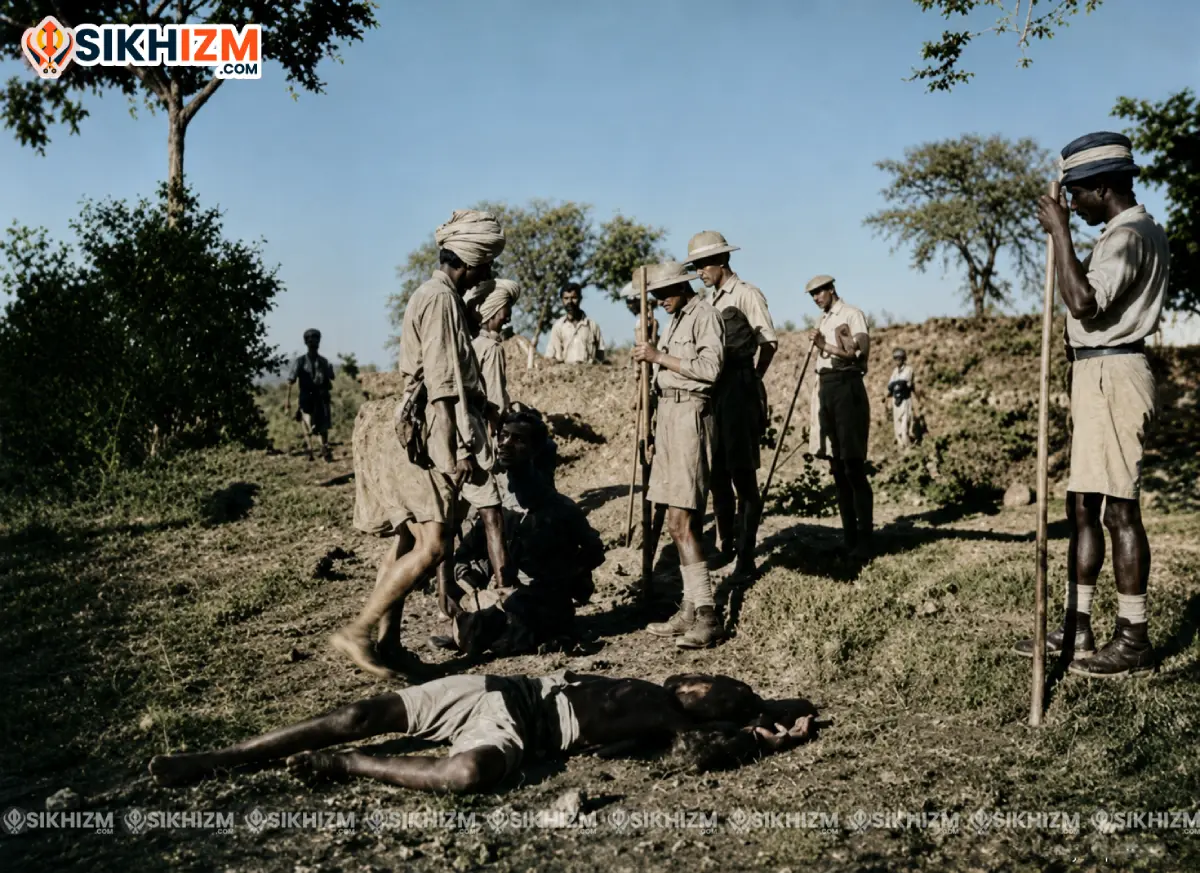
03
of 05Eyewitness Accounts & National / Global Impact
The Guru Ka Bagh Morcha did not remain a local Punjab affair — it became a national and international story, drawing support and testimony from figures far beyond the Sikh community.
- Rev. C.F. Andrews, in his book An Indian Diary and other writings (his account is also referenced in A Brief Account of the Sikh People), described the discipline of the Akali volunteers as deeply moving, writing candidly about the brutality he witnessed and the volunteers' unwavering calm even as they were struck.
- Pandit Motilal Nehru, one of the most senior Congress leaders of the era and father of Jawaharlal Nehru, personally visited the site and later wrote of the Akali volunteers: "It has impressed me with the deepest respect and admiration for the brave Akalis. I salute them with all reverence. They are the finest people that have ever inhabited any part of the world."
- Lala Lajpat Rai, the noted freedom fighter, published a Hindi poem in the newspaper Bande Mataram honouring the Akali volunteers as the "messiahs" of India's suffering, predicting that when India finally won self-rule, its flag would fly in Akali hands.
- Muslim community leaders and editors also voiced solidarity — the Urdu newspaper Inquilab, edited by Sadiq Hasan, published editorials praising the bravery of the Akali Sikhs, while Khilafat Movement leaders Maulana Muhammad Ali and Mian Muhammad Shafi personally attended the protests in a striking display of Hindu–Muslim–Sikh unity during the freedom struggle.
- The All India Congress Committee, at its working committee meeting on 27 September 1922, formally passed a resolution setting up an independent inquiry committee under S. Srinivasa Iyengar (former Advocate General of Madras) and Prof. Ruchi Ram Sahni. Their findings were published as the "Guru Ka Bagh Congress Enquiry Committee" report, one of the earliest formal documentations of colonial police brutality against a non-violent protest movement in India.
- British author John S. Hoyland also documented the Morcha in his book The Cross Moves East, presenting it to Western readers as a landmark example of organised non-violent resistance — years before the term "satyagraha" became globally associated primarily with Gandhi's later campaigns.
Sikh eyewitnesses who survived the beatings recalled volunteers marching forward with faces "radiant," continuously reciting "Satnam Sat Kartar, Waheguru" even as blows fell on them, and refusing — without exception — to raise a hand in retaliation or attempt to flee. This extraordinary discipline, sustained across three months and thousands of volunteers, is what elevated the Guru Ka Bagh Morcha from a local dispute into a defining case study of non-violent civil resistance anywhere in the world.
04
of 05Resolution & Legacy
How the Morcha Ended
Unable to suppress the movement through force or arrests, and facing mounting embarrassment both nationally and internationally, the British administration turned to Sir Ganga Ram, a highly respected civil engineer and philanthropist who had studied in England and spent over a decade (1885–1897) shaping Lahore's built environment — designing landmarks such as Lahore Museum, the High Court building, the Delhi Secretariat, and Aitchison College. On 17 November 1922, roughly three months after it began, the government arranged for the land to be handed back — via Sir Ganga Ram acting as an intermediary between Mahant Sundar Das and the SGPC.
On 18 November 1922, at a special diwan held at Sri Akal Takht Sahib, Sir Ganga Ram publicly declared: "This land belongs to the gurdwara and always will. I am merely a humble servant of the Guru's house, and I hereby formally request the SGPC to accept it." With that, the Morcha Guru Ka Bagh was officially declared won.
The Human Cost
Between 22 August and 17 November 1922, the Morcha claimed an extraordinary toll:
- 5,605 Sikh volunteers arrested
- Approximately 1,500 injured, many severely
- Several martyred, either during the beatings, in jail, or at Saka Sri Panja Sahib
Remarkably, the SGPC financed the entire campaign — food, medical care, legal defence, and support for prisoners' families — entirely through community donations, without a single rupee of outside political funding, a fact often highlighted as proof of the movement's grassroots legitimacy.
The Martyrs of Guru Ka Bagh
The following Sikh volunteers are remembered as shaheeds (martyrs) of the Morcha:
- Bhai Bhagat Singh and his grandson Bhai Tara Singh (village Tera Khurd) — beaten to death by police
- Bhai Karam Singh (Sri Amritpur Sahib) and Bhai Partap Singh (Khazanchi, Gurdwara Sri Panja Sahib) — martyred at Saka Sri Panja Sahib
- Bhai Hari Singh — martyred in Amritsar Jail
- Bhai Prakash Singh — martyred the day after his release from jail, from injuries sustained in custody
- Bhai Hardit Singh (Adhwal, Jalandhar) — martyred in Lahore Borstal Jail
- Bhai Jawala Singh (Panjaula, Hoshiarpur) and Bhai Bishan Singh (Sohal, Gurdaspur) — martyred in Attock Jail
- Jathedar Prithipal Singh — succumbed to his injuries in hospital while still in police custody
Their memory is preserved today at the Yaadgar Shaheedan (Martyrs' Memorial), located within the parikrama of Gurdwara Guru Ka Bagh, close to the memorial commemorating Guru Tegh Bahadur Ji's own visit to the site.
Aftermath: Release of Prisoners
In March 1923, a resolution was passed for the unconditional release of all Sikhs imprisoned in connection with the Morcha. Even this process was not free of further violence: on 5 May 1923, some 450 released prisoners were again mistreated by police at Rawalpindi railway station, with about 50 fainting from the assault before being hospitalised — a bitter coda to an already harrowing struggle.
Legacy for the Gurdwara Reform Movement and India's Freedom Struggle
The Guru Ka Bagh Morcha stands as one of the defining victories of the Gurdwara Reform Movement (1920–1925), which ultimately led to the landmark Sikh Gurdwaras Act of 1925, permanently transferring control of historic Sikh shrines from hereditary mahants to democratically elected SGPC management — a structure that continues to this day.
Beyond its religious significance, the Morcha carries enormous weight in India's broader freedom struggle. It demonstrated, years ahead of many later satyagraha campaigns, that sustained, disciplined non-violent resistance could force even a powerful colonial government to back down — without a single act of retaliatory violence from the protesters. It cemented cross-community solidarity between Sikhs, Hindus, and Muslims at a critical juncture in the national movement, and it produced martyrs — particularly at Saka Sri Panja Sahib — whose sacrifice remains among the most revered in modern Sikh history.
05
of 05Frequently Asked Questions (FAQ)
1. What was the Guru Ka Bagh Morcha?
The Guru Ka Bagh Morcha was a non-violent Sikh protest movement in 1922 at Gurdwara Guru Ka Bagh, near Amritsar, in which unarmed Akali volunteers courted arrest and beating by British police to reclaim gurdwara land and management from a corrupt mahant, as part of the wider Gurdwara Reform Movement.
2. When did the Guru Ka Bagh Morcha take place?
The core confrontation lasted roughly three months, from 22 August 1922 to 17 November 1922, though the underlying dispute and arrests began slightly earlier in August 1922, and the release of imprisoned volunteers continued into 1923.
3. Who was Mahant Sundar Das?
Mahant Sundar Das was the hereditary custodian of Gurdwara Guru Ka Bagh who, after initially agreeing to manage the shrine under SGPC oversight, reneged on that agreement and, allegedly with British encouragement, filed theft charges against Sikh volunteers for routine wood-cutting, triggering the Morcha.
4. Who were the martyrs of the Guru Ka Bagh Morcha?
Recognised martyrs include Bhai Bhagat Singh and his grandson Bhai Tara Singh, Bhai Hari Singh, Bhai Prakash Singh, Bhai Hardit Singh, Bhai Jawala Singh, Bhai Bishan Singh, Jathedar Prithipal Singh, and Bhai Karam Singh and Bhai Partap Singh, who gave their lives at the related event known as Saka Sri Panja Sahib.
5. How did the Guru Ka Bagh Morcha end?
The morcha ended on 17 November 1922 when the British government, unable to break the volunteers' resolve through violence or mass arrests, arranged — through the respected engineer Sir Ganga Ram — for the disputed gurdwara land to be formally returned to the SGPC.
6. What was the significance of the Guru Ka Bagh Morcha in India's freedom struggle?
It was one of the earliest large-scale demonstrations that disciplined non-violent resistance could defeat colonial force, drawing support from Congress leaders, Muslim leaders, and international observers like Rev. C.F. Andrews — and directly contributed to the passage of the Sikh Gurdwaras Act, 1925.
Sources: This article draws on the Punjabi-language accounts published by the Dharam Parchar Committee, Shiromani Gurdwara Parbandhak Committee, Sri Amritsar, and by the Sikh Missionary College (Regd.), Ludhiana.
Download Free PDF Book
Morcha Guru Ka Bagh PDF Book
Download Morcha Guru Ka Bagh PDF Book, written by Dr. Simranjit Kaur. It is a digitized version of 20 Page...