

Nanakshahi Calendar – Sikh Calendar Explained
The Nanakshahi Calendar represents a pivotal shift in how the global Sikh community (the Panth) organises its sacred time, historical commemorations, and religious identity. Designed to replace the traditional Bikrami calendar, it is a solar calendar specifically tailored to the requirements of the Sikh faith, ensuring that significant events align with the seasons as described in the Guru Granth Sahib.
What is the Nanakshahi Calendar?
The Nanakshahi Calendar is the official calendar of Sikhism, adopted by the Shiromani Gurdwara Parbandhak Committee (SGPC) to determine the dates for important Sikh events. Its epoch, or starting point (Year One), is the birth of the first Sikh Guru, Guru Nanak Dev Ji, in 1469 CE.
Key Features of the Original Nanakshahi Calendar (Mool):
- Solar-Based: Unlike the lunar-based Bikrami system, the Nanakshahi calendar is based on the tropical solar year.
- Year Length: It follows a year length of 365 days, 5 hours, 48 minutes, and 45 seconds, matching the mechanics of the Western (Gregorian) calendar.
- Sikh New Year: The year begins on 1 Chet, which corresponds to 14 March in the Gregorian calendar.
- Month Structure: The first five months consist of 31 days, followed by seven months of 30 days.
- Leap Years: A leap year occurs every four years, with an extra day added to the last month, Phagun.
But there is a BIG CONTROVERSY.
Mool Nanakshahi Vs Nanakshahi Calendar adopted by SGPC
You heard it right; there are two Nanakshahi Calendars:
- Original Nanakshahi Calendar crafted by Pal Singh Purewal
- Nanakshahi Calendar adopted by Shiromani Gurudwara Prabandhak Committee (SGPC, Sri Amritsar Sahib) post 2014.
The calendar the SGPC currently uses (post-2014) is for all intents and purposes the Bikrami calendar, even though they continue to label it "Nanakshahi."
1. The Original Vision (Purewal’s Nanakshahi)
Pal Singh Purewal’s goal was to move from a luni-solar system (Bikrami) to a solar system.
The Logic: In the Bikrami system, dates shift because it follows lunar cycles. This led to "anomalies" where a Gurpurab might happen twice in one Gregorian year or not at all.
The Solution: Purewal fixed the dates (e.g., Guru Gobind Singh Ji's Parkash Purab on January 5th, Vaisakhi on April 14th). This version was officially adopted by the SGPC in 2003.
2. The 2010 "Hodgepodge" and 2014 Reversion
The conflict arose from traditionalist groups (like the Sant Samaj) who argued that changing the dates broke with centuries of tradition.
2010: Under political pressure, the SGPC released a "modified" Nanakshahi calendar. It was a confusing hybrid—it kept Purewal's month names but reverted the most important Gurpurabs (Guru Nanak Dev Ji’s birth, Hola Mohalla, Diwali/Bandi Chhor Divas) back to the movable Bikrami dates.
2014/2015: Eventually, the SGPC almost entirely abandoned the fixed-date system. They reverted to the lunar-based Bikrami calculations for nearly all major events but kept the name "Nanakshahi" on the printouts. This is why you find no difference today; it is the Bikrami system in a Nanakshahi wrapper.
3. "Mool Nanakshahi" vs. "SGPC Nanakshahi"
Because of this reversion, the original 2003 version (the one Purewal actually crafted) was branded as the Mool (Original) Nanakshahi Calendar to distinguish it from the SGPC's version.
- Mool Nanakshahi: Used by many diaspora Gurdwaras (USA, Canada, UK) and the Pakistan Sikh Gurdwara Parbandhak Committee (PSGPC). It uses fixed dates.
- SGPC "Nanakshahi": Used by the SGPC in India. It uses shifting lunar dates (Bikrami).
| Feature | Mool Nanakshahi (Purewal) | SGPC "Nanakshahi" (Current) |
|---|---|---|
| System | Tropical Solar (Fixed) | Luni-Solar (Shifting/Bikrami) |
| Vaisakhi | Always April 14 | Shifting (usually April 13/14) |
| Guru Nanak Dev Ji Birth | Always April 14 (or fixed Katak date) | Shifting (Katak Puranmashi) |
| Identity | Independent Sikh Calendar | Linked to Bikrami/Hindu Calendar |
The Historical Need for a Sikh Calendar
For centuries, Sikhs used the Bikrami calendar, a lunar-solar system rooted in Hindu tradition. However, this led to several theological and practical issues that necessitated the creation of a distinct Sikh chronological system.
The Problem with the Bikrami System
The Bikrami calendar is based on the sidereal year and the movement of the moon. Because a lunar year (approx. 354 days) is about 11 days shorter than a solar year, the dates for Gurpurabs (anniversaries of the Gurus) would "wander" through the Gregorian calendar.
To keep the lunar year aligned with the solar seasons, the Bikrami system adds an extra month (Laund or Mal-maas) approximately every three years. In traditional Hindu belief, these extra months are often considered inauspicious (ashubh), and no sacred ceremonies are performed during them.
Alignment with Gurbani
The Sikh scriptures, specifically the Barah Maha (Twelve Months) compositions, describe the relationship between the human soul and the Divine through the changing seasons. Because the Bikrami calendar shifts over time—losing about one day every 71 to 72 years—the months eventually drift out of their seasonal context. The Nanakshahi Calendar was designed to be fixed to the tropical year, ensuring that Vaisakh always occurs in the spring and Poh always occurs in the winter, forever preserving the seasonal link intended in Gurbani.
The Creation and Adoption (1999–2003)
The Nanakshahi Calendar was developed by Pal Singh Purewal, a Canadian Sikh and retired computer engineer, who began work on the project in the 1960s. His goal was to create a calendar that reflected the "sovereignty" and "distinct identity" of the Sikh religion, similar to how the Islamic world uses the Hijri calendar.
A committee formulated by the Institute of Sikh Studies, Chandigarh, studied Purewal’s proposals. In 1999, during the 300th anniversary of the Khalsa’s creation, the calendar was implemented in principle. It was formally accepted and launched by the SGPC in 2003.
The 2010 Amendments and Controversy
Despite its initial success and widespread adoption by the global Sikh diaspora, the Nanakshahi Calendar became a subject of internal dispute.
The "Amended" Nanakshahi Calendar
In 2010, under pressure from certain traditionalist groups known as the Sant Samaj, the SGPC introduced amendments to the calendar. This "amended" version reverted several key dates back to the lunar Bikrami system, including:
1. Birthday of Guru Gobind Singh Ji
2. Martyrdom of Guru Arjan Dev Ji
3. Guriaai (Guruship) of the Guru Granth Sahib
Critics argue that these changes "torpedoed" the original intent of the calendar, re-introducing the confusion of wandering dates and the concept of "inauspicious" months, which contradicts Sikh philosophy. Today, many Gurdwaras follow the original 2003 calendar, while others follow the 2010 amended version, leading to the celebration of Gurpurabs on different days across the world.
Month Structure in Nanakshahi Calendar
The Nanakshahi year is divided into twelve months as per the following table: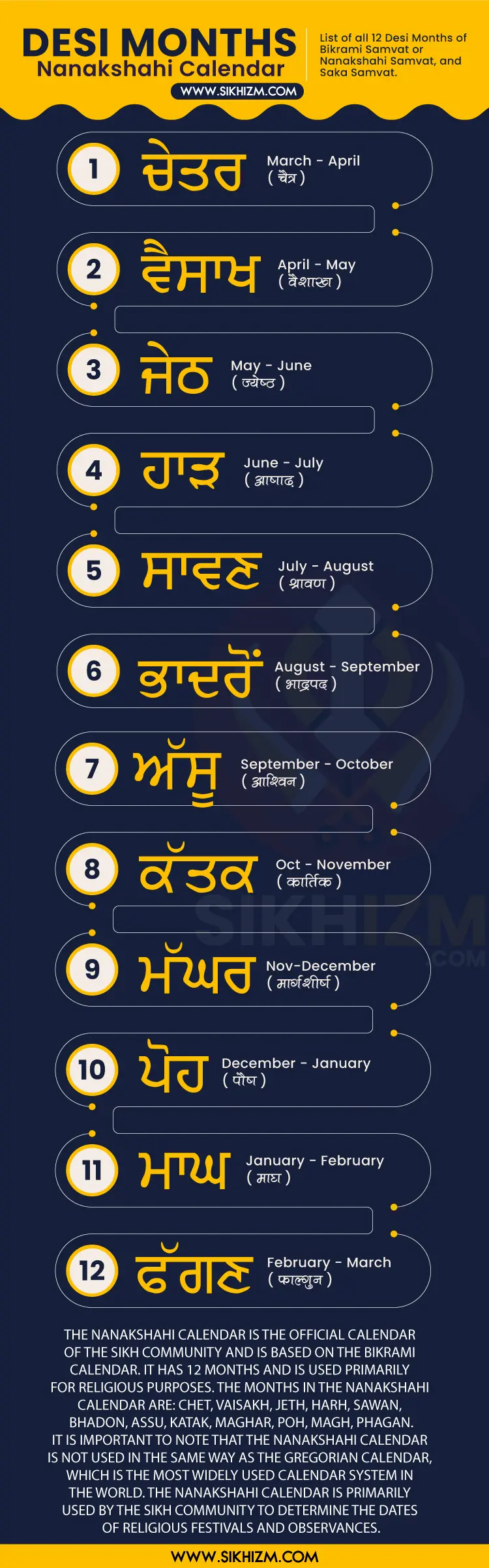
However in the fixed date system of Original Nanakshahi Samvat Sangrand dates are fixed as per the following table:
| Nanakshahi Month | Gregorian Start Date | Number of Days |
|---|---|---|
| Chet | 14 March | 31 |
| Vaisakh | 14 April | 31 |
| Jeth | 15 May | 31 |
| Harh | 15 June | 31 |
| Sawan | 16 July | 31 |
| Bhadon | 16 August | 30 |
| Assu | 15 September | 30 |
| Katak | 15 October | 30 |
| Maghar | 14 November | 30 |
| Poh | 14 December | 30 |
| Magh | 13 January | 30 |
| Phagun | 12 February | 30 / 31* |
*Phagun has 31 days if the following Gregorian year is a leap year.